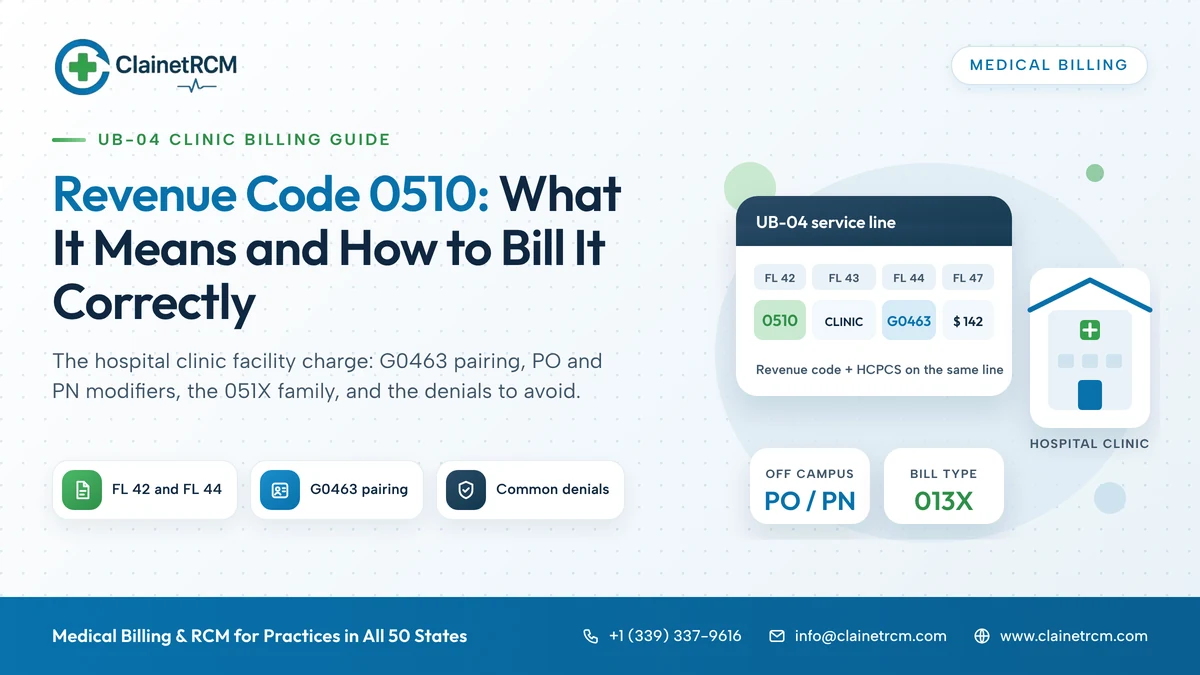
Quick answer: Revenue code 0510 is a four digit NUBC code that tells the payer a patient received general outpatient clinic services in a hospital owned or provider based clinic. It is reported on the UB-04 (or 837I) as the facility charge for the room, nursing support and clinic overhead. The provider’s own work is billed separately with CPT or HCPCS codes.
If you bill for a hospital clinic, you will see 0510 on almost every outpatient visit claim. It looks simple, and that is exactly why it gets misused. I have reviewed a lot of clinic claims over the years, and the denials tied to this code rarely come from the code itself. They come from what sits next to it on the claim.
This guide covers what 0510 means, who can use it, what to pair it with, how it differs from its neighbors in the 051X and 052X families, and how to fix the denials it tends to attract.
Revenue Code 0510 at a Glance
| Item | Detail |
|---|---|
| Code | 0510 |
| NUBC description | Clinic, general classification |
| Claim form | UB-04 (CMS-1450) or 837I electronic claim |
| Not used on | CMS-1500 professional claims |
| Typical bill type | 013X (hospital outpatient) |
| Typical setting | Hospital owned or provider based outpatient clinic |
| Usually paired with | HCPCS G0463 (Medicare) or an E/M code per payer policy |
| Reported in | UB-04 Form Locator 42 |
What Revenue Code 0510 Actually Means
A revenue code groups charges by the type of service or department that produced them. Revenue code 0510 groups charges from a general clinic. It answers one question for the payer: where in the facility did this service happen?
It does not say what the clinician did. That job belongs to the HCPCS or CPT code on the same line. Think of it this way: the revenue code describes the place and resources, and the procedure code describes the work.
A patient comes to a hospital owned primary care clinic for a blood pressure follow up. A nurse takes vitals, the patient sits in an exam room, and the physician reviews medications and adjusts a prescription. The hospital reports revenue code 0510 for the clinic resources. The physician reports an E/M code for the professional service. Two parts, two claims, one visit.
Where 0510 Appears on the Claim
On the paper UB-04, each service line carries these fields:
- FL 42: the revenue code (0510)
- FL 43: a short description, such as “CLINIC”
- FL 44: the HCPCS or CPT code for that line
- FL 45: the service date
- FL 46: service units
- FL 47: total charges for the line
On the electronic 837I, the revenue code and procedure code travel together on the service line segment. If your clearinghouse flags a line, check that the revenue code and procedure code fields both populated correctly. Our walkthrough of clean claims in medical billing shows how front end edits like this catch problems before the payer does.
Who Can Use Revenue Code 0510
This is where most confusion starts. Revenue code 0510 is meant for clinics that operate as part of a hospital, either on the main campus or as a provider based department off campus. These are facilities billing on an institutional claim, with the hospital as the billing entity.
A freestanding physician practice that is not part of a hospital does not bill a facility fee at all. It bills on the CMS-1500 and has no use for 0510. Rural health clinics and other freestanding facilities have their own codes in the 052X series.
One point worth stating plainly: provider based status is not something a hospital can simply declare. For Medicare, the clinic has to meet the provider based requirements in 42 CFR 413.65. If that status is shaky, the facility fee is exposed during an audit. Hospital billing teams should confirm status with compliance before building a clinic’s charge setup. If you manage billing for a hospital, our page for hospital revenue cycle support explains how we handle this kind of setup work.
Facility Claim vs Professional Claim
Provider based clinic visits create two bills.
| Facility claim | Professional claim | |
|---|---|---|
| Form | UB-04 / 837I | CMS-1500 / 837P |
| Billed by | Hospital | Physician or group |
| Revenue code | Yes (0510) | No |
| Procedure code | G0463 or E/M per payer | CPT E/M and procedures |
| Place of service | Not reported the same way | 19 (off campus) or 22 (on campus) |
The professional claim uses place of service 19 or 22 so the payer knows the physician worked in a hospital outpatient department. Payers then pay the professional fee at the facility rate, which is lower because the hospital is collecting its own fee. If you are working on the physician side of the same visit, our guide to CPT code 99213 is a useful reference for the E/M level most clinic visits land on.
What to Pair With Revenue Code 0510
A revenue code without a matching procedure code is a common reason for rejection. Most outpatient payers require a HCPCS or CPT code on lines that carry 0510.
Medicare. Under OPPS, hospitals report HCPCS G0463, the hospital outpatient clinic visit for assessment and management of a patient, for the facility side of a clinic visit. It replaces the E/M level on the facility claim, so the hospital does not report 99213 or 99214 the way the physician does.
Commercial payers. Policies vary. Some accept G0463, some want the E/M code that matches the visit level, and some pay based on the revenue code alone under a contract rate. Always read the payer’s institutional billing policy before assuming Medicare rules apply.
Modifiers for off campus clinics. For Medicare, off campus provider based departments report a modifier on the facility line:
- PO: services furnished in an excepted off campus provider based department
- PN: services furnished in a nonexcepted off campus provider based department
On campus clinics generally do not report these. Missing or wrong modifiers change payment, so this is worth checking on every new clinic location.
Revenue Code 0510 and Site Neutral Payment
Since the 2019 OPPS rule, CMS has paid clinic visits (G0463) at excepted off campus departments at a rate equal to the physician fee schedule equivalent, instead of the full OPPS rate. The reduction was phased in over two years, and the policy has stayed in place since. CMS has continued to push site neutral payment in later rules, so check the current year’s OPPS final rule before you forecast revenue for any off campus clinic.
For billing teams, the practical takeaway is simple. Do not assume that being a hospital clinic means being paid a hospital rate. Where the clinic sits, and when it was established, decides what Medicare pays.
The 051X Clinic Family
Revenue code 0510 is the general code. The rest of the 051X series is more specific, and many hospitals use these to track cost centers.
| Code | NUBC description |
|---|---|
| 0510 | Clinic, general classification |
| 0511 | Chronic pain center |
| 0512 | Dental clinic |
| 0513 | Psychiatric clinic |
| 0514 | OB-GYN clinic |
| 0515 | Pediatric clinic |
| 0516 | Urgent care clinic |
| 0517 | Family practice clinic |
| 0519 | Other clinic |
Use the specific code only when your chargemaster and the payer both support it. Many payers process every 051X code the same way, and some reject the narrower ones. If the clinic type is not in the list, 0519 is the correct “other” code, not 0510.
Do not confuse these with the 052X series, which covers freestanding clinics, including rural health clinics. A 0510 line on a freestanding claim is a wrong code, not a harmless shortcut.
How to Bill Revenue Code 0510 Step by Step
- Confirm the clinic is provider based. Check on campus or off campus status and which modifier applies.
- Map the chargemaster. Each clinic charge description should point to the right revenue code and procedure code. Errors in the chargemaster repeat on every claim.
- Capture the visit level. Know whether the payer wants G0463 or an E/M code on the facility line.
- Build the institutional claim. Use the correct bill type, usually 013X for hospital outpatient, with 0510 in FL 42 and the procedure code in FL 44.
- Add modifiers. Apply PO or PN where Medicare requires them. Add modifier 25 on the professional E/M line when a separate procedure was done the same day.
- Bill the professional claim separately. Use the correct place of service, 19 or 22.
- Scrub before submission. Check revenue code to procedure code pairing, units, and charges.
- Work rejections the same day. Do not let a clearinghouse reject sit for a week.
Bill types matter here. Hospital outpatient claims use the 013X family, while inpatient stays use different bill types, as covered in our explainer on type of bill 111. Mixing them up sends the claim to the wrong processing logic.
Common Denials on 0510 Lines and How to Fix Them
| Problem | Likely cause | Fix |
|---|---|---|
| Revenue code requires procedure code | Line has 0510 with no HCPCS | Add G0463 or the payer required code |
| Revenue code and procedure mismatch | Wrong code for payer policy | Review payer institutional policy, correct line |
| Missing PO or PN modifier | Off campus clinic not flagged | Update the chargemaster modifier logic |
| Duplicate line denial | Same visit reported twice | Check units and dates of service |
| Provider based status denied | Clinic does not meet the requirements | Escalate to compliance before rebilling |
| Billed on CMS-1500 | Facility fee on a professional form | Rebill on UB-04 / 837I |
A denial is a signal about your process, not just a single claim. If the same edit fires repeatedly, the chargemaster or front end is wrong. Our overview of claim denial prevention goes deeper on tracing denials to their source, and our denial management services team can take over appeals when volume gets heavy.
What Revenue Code 0510 Pays
There is no single national price for 0510. The code is a classification, not a payment. What you receive comes from the procedure code on the line, the payer contract, the payment system (OPPS for Medicare), and the clinic’s location and status.
Be careful with pages that publish a “national average” for 0510 by payer. Negotiated rate data for this code spans a wide range even within one payer, from small per line amounts to several hundred dollars, because contracts bundle and price clinic visits differently. A single average hides that spread and can lead to bad budgeting. Use your own contracts and remittances instead.
Documentation That Supports a 0510 Line
Auditors look for a clear story. The record should show:
- Medical necessity for the visit
- That the service took place in a qualifying hospital clinic
- The level of service, supported by the clinician’s note
- Clinic resources used, such as nursing assessment and exam room
- Orders and results tied to the same date
If the note cannot support the level you billed, the revenue code will not save the claim.
Mistakes I See Most Often
- Using 0510 for freestanding clinics. The facility is not provider based, so the code does not apply.
- Using 0510 for telehealth. The 051X family is for in person clinic services. Telehealth follows its own payer rules and codes.
- Leaving out the procedure code. Many payers reject a bare 0510 line.
- Copying Medicare rules to every payer. Commercial policies differ.
- Ignoring modifiers PO and PN. This quietly reduces payment or triggers denials.
- Never auditing the chargemaster. One wrong mapping repeats on thousands of claims.
Related Revenue Codes Worth Knowing
If your team bills other hospital departments, you will run into related revenue codes on the same claims. We cover revenue code 0250 for pharmacy, revenue code 0360 for operating room services, and revenue code 636 for drugs requiring detailed coding. Reading them together helps you see how a full outpatient claim fits.
Frequently Asked Questions
It is the NUBC code for general clinic services in a hospital owned outpatient clinic. It represents the facility charge for the visit and is reported on the UB-04.
No. A revenue code identifies the department or service type. A CPT or HCPCS code identifies the specific service performed.
No. Revenue codes belong on institutional claims, meaning the UB-04 or 837I. The CMS-1500 is for professional billing.
Medicare hospital outpatient clinic visits are reported with G0463 on the facility line, with PO or PN where applicable.
Generally no. It is meant for hospital owned or provider based clinics. Freestanding clinics use the 052X series if they bill on an institutional form, and most private practices bill only professional claims.
It is meant for in person clinic services. Follow the payer’s telehealth policy for the correct codes.
0510 is for hospital based clinics. 0520 begins the freestanding clinic series.
Modifiers attach to procedure codes, not revenue codes. For off campus Medicare clinics, PO or PN goes on the G0463 line.
Hospital outpatient claims typically use the 013X bill type family.
Final Thoughts
Revenue code 0510 is easy to learn and easy to get wrong. Get three things right and most problems disappear: confirm the clinic is truly provider based, pair the code with the correct procedure code and modifier, and keep the chargemaster clean. Do that, and your facility claims move faster, with fewer reworks and fewer audit surprises.
Is your hospital clinic leaving facility revenue on the table? Wrong revenue code pairings, missing modifiers and chargemaster errors quietly drain clinic revenue every month. The Clainet RCM team audits your facility claims, fixes the root causes and keeps your denials down.
Talk to a Clainet RCM billing specialist
Written by
ClainetRCM Billing Team
ClainetRCM is a Boston-based revenue cycle management company specializing in medical billing, coding, credentialing and denial management for healthcare providers across all 50 states. Our AAPC and AHIMA certified team works inside your existing EHR, files claims within 24 to 48 hours and reviews every AR bucket on a 14-day cycle.