
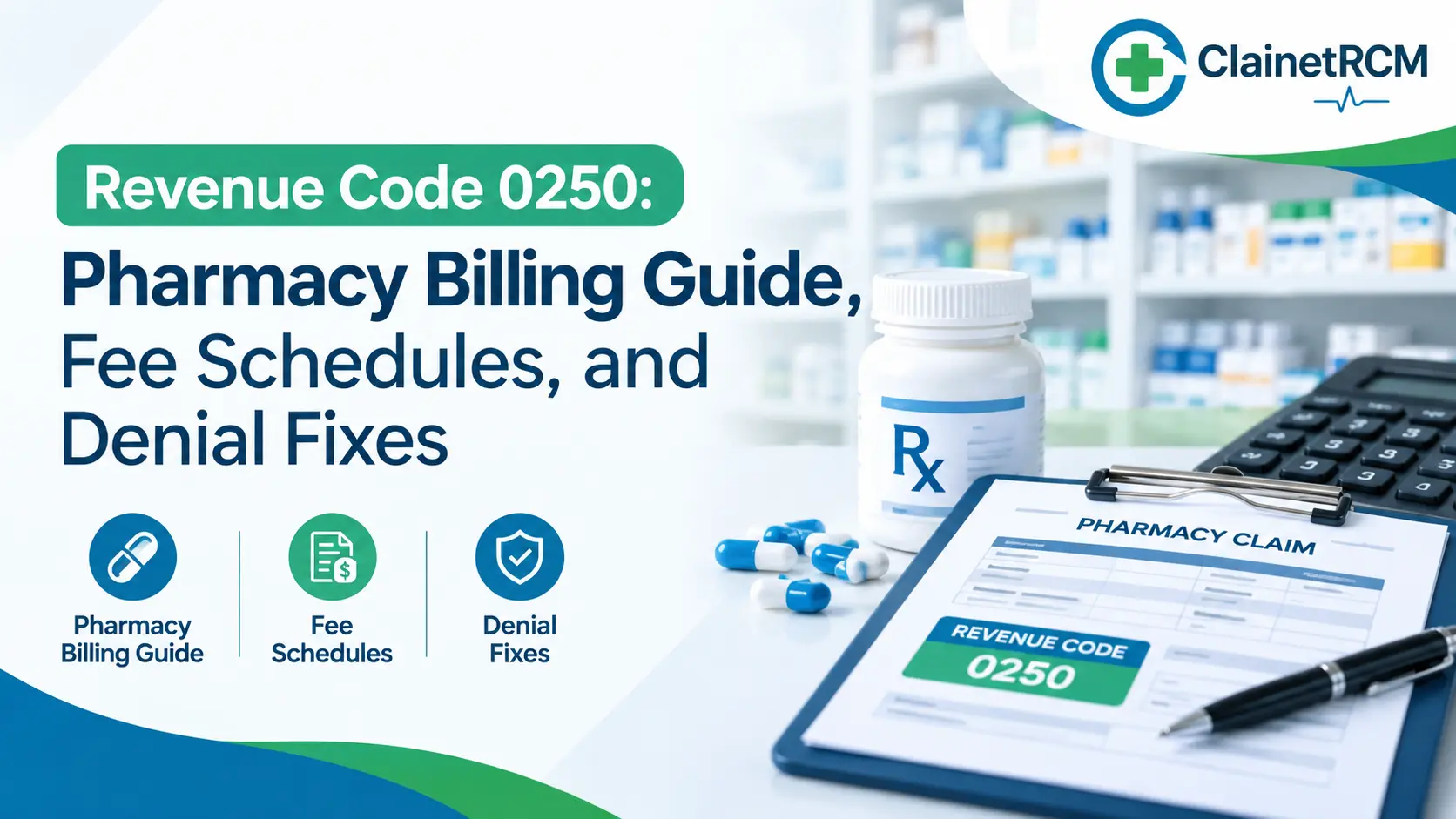
If a line on your UB-04 shows revenue code 0250 and you are not sure why it is there or whether it is going to get paid, here is the short answer: 0250 tells the payer that a charge came from the hospital's pharmacy department, not what drug was given. The drug itself is identified by a separate HCPCS or NDC code on the same claim line. Get that pairing wrong, or leave out the supporting code the payer wants, and the line denies.
Everything below covers what 0250 means, where it shows up, how Medicare, Medicaid, and commercial payers actually pay it in 2026, the modifiers and drug-waste rules coders keep missing, and a denial checklist you can hand to your billing team today.
What Does Revenue Code 0250 Mean?
Revenue code 0250 is the general classification code for pharmacy charges on an institutional claim (UB-04 or its electronic equivalent, the 837I). It sits inside the 025X series, which the National Uniform Billing Committee reserves for pharmacy.
Think of it as a cost-center marker, not a drug identifier. It answers one question for the payer: which hospital department is billing for this item? If the answer is the pharmacy, the revenue code is 0250. The actual medication, its strength, and the route it was given are reported separately, almost always with a HCPCS/CPT code and often an 11-digit NDC.
That is why a single pharmacy charge frequently shows up as a pair on the claim:
- 0250 (revenue code): the department, meaning pharmacy
- J-code or Q-code (HCPCS): the specific drug
- NDC (when the payer requires it): the exact manufacturer and package
A patient treated in the ER for a kidney infection who receives IV antibiotics and IV fluids will have both charges land under 0250, because both came out of the pharmacy, while the HCPCS/NDC pair on each line tells the payer exactly which drug and how much of it was used.
Where You Will See Revenue Code 0250
Code 0250 shows up most often on:
- Emergency department visits where injectable or infused medications are given
- Outpatient infusion and chemotherapy suites
- Outpatient clinics attached to a hospital
- Observation stays
- Inpatient claims, since 0250 identifies the department regardless of admission status; whether the stay is billed as inpatient or outpatient depends on the type of bill, not the revenue code
It is a facility-side code. Independent physician offices, urgent care clinics that bill professionally, and ambulatory practices that submit CMS-1500 claims do not use it, because 0250 belongs to institutional, UB-04-style billing.
The 025X Family: How 0250 Relates to 0251, 0252, 0253, and 0258
Facilities that want more granular pharmacy tracking break charges out under related codes instead of lumping everything into 0250:
| Code | Category | Typical Use |
|---|---|---|
| 0250 | Pharmacy, general classification | Default pharmacy charge when a facility does not subdivide by drug type |
| 0251 | Generic drugs | Generic medications, usually reimbursed at a lower rate than brand-name |
| 0252 | Non-generic (brand) drugs | Higher-cost brand medications, often subject to prior authorization |
| 0253 | Take-home drugs | Medications the facility dispenses for the patient to take home; many payers apply self-administered drug exclusions here |
| 0258 | IV solutions | Intravenous fluids billed apart from the medications infused through them |
| 0636 | Drugs requiring detailed coding | Extension of the 025X series for high-cost drugs some payers want billed with more specific detail than 0250 allows |
If your facility does not separate pharmacy charges by type, 0250 is the safe default for general drug dispensing that does not fit one of the more specific buckets above.
When to Use Revenue Code 0250
Use 0250 when all three of these are true:
- The claim is an institutional (facility) claim from a hospital or hospital-based department, not a professional office claim.
- The charge is for a drug or a pharmacy-supplied item.
- The facility tracks the charge under its general pharmacy cost center rather than a more specific pharmacy sub-code.
When Not to Use Revenue Code 0250
Skip 0250 in these situations:
- The claim comes from an office, urgent care, or independent clinic billing professionally rather than as a hospital facility
- The charge belongs to a non-pharmacy department such as lab, imaging, or a procedure that is not drug-related
- The medication is going home with the patient and your facility separately tracks take-home drugs under 0253
- The payer has specifically instructed you to use a more detailed pharmacy code, such as 0636, for that drug
Revenue Code 0250 Reimbursement: Medicare, Medicaid, and Commercial Payers in 2026
Payment rules differ sharply by payer type, and this is where most billing teams lose money without realizing it.
Medicare (OPPS)
Under the Outpatient Prospective Payment System, Medicare packages most drugs billed under 0250 into the payment for the overall visit rather than paying them as a separate line item. The packaged charge gets folded into the Ambulatory Payment Classification (APC) for that encounter.
The packaging decision generally comes down to cost:
- Below the per-day drug packaging threshold (CMS has held this near $140 per day for several update cycles, so confirm the current OPPS addendum before you finalize a fee schedule): the drug is packaged, and there is no separate payment.
- Above the threshold, or the drug carries pass-through status: Medicare pays separately, typically using one of two formulas:
- ASP + 6%, the standard formula for most separately payable Part B drugs. A $100 ASP drug pays around $106 before adjustments.
- WAC + 3%, used when no ASP is published. A $200 WAC drug pays around $206 before adjustments.
Sequestration and other statutory adjustments can shave a small percentage off either calculation, so treat these formulas as a starting point, not the final remit.
Medicaid
Medicaid rules for 0250 vary by state, but a common thread runs through nearly all of them: both a HCPCS drug code and an 11-digit NDC are expected on the claim line, especially for outpatient hospital drug billing tied to federal rebate requirements. States that have published explicit guidance on this include North Carolina, which will deny 025X and 063X lines missing NDC or HCPCS data, and Maryland, which requires NDC reporting on outpatient claims carrying revenue codes in the 0250 range.
Some state Medicaid programs also pay outpatient drugs based on the submitted CPT/HCPCS code rather than bundling everything the way Medicare's OPPS does, so a rate that is packaged under Medicare might still generate a separate Medicaid payment.
Commercial and Private Payers
There is no single fixed 0250 rate across commercial insurers. Payment depends on the specific payer, the contracted fee schedule, and geography. Reported average payments for a general 0250 pharmacy line vary widely between major carriers, which is exactly why practices with a heavy infusion or specialty-drug caseload should pull their own contracted rates rather than assume a market average.
Modifiers and Drug-Waste Rules Billers Often Miss
Two rules trip up more 0250 claims than almost anything else in 2026:
- JW modifier, used to report the amount of a single-dose vial that was discarded and not administered to the patient. Since CMS made JW reporting mandatory for applicable single-dose drugs, missing it on a claim where waste clearly occurred is a fast track to a documentation-related denial or audit flag.
- JZ modifier, the companion modifier confirming that there was no discarded drug on a single-dose vial. CMS now expects JZ on qualifying claims specifically so payers can tell the difference between "waste, properly reported" and "waste, not reported at all."
- 340B-related modifiers (such as TB or UD, depending on payer instructions), which apply when the drug was acquired through the 340B Drug Pricing Program and change how the line is priced.
If your EHR documentation does not capture vial size versus administered dose at the point of care, your coders cannot apply JW/JZ correctly downstream, and that gap is one of the most common root causes behind pharmacy-line denials our medical coding team sees in chart audits.
How to Bill Revenue Code 0250 Correctly
- Confirm eligibility. Was this a pharmacy service provided in an outpatient or inpatient hospital setting, dispensed or administered by the facility? If yes, 0250 is on the table.
- Document every detail of the medication. Drug name (generic and brand), route of administration, quantity given, charge amount, the ICD-10 code supporting medical necessity, the CPT/HCPCS administration code, and the ordering provider's information.
- Pair 0250 with the correct HCPCS/CPT code. The revenue code identifies the department; the HCPCS code (often a J-code) identifies the drug; a CPT code such as 96365 identifies the administration (an initial IV infusion, for example). Payers need all three pieces to process the line.
- Check payer-specific rules before you submit. Does this payer bundle the drug, require an NDC, or ask for prior authorization? Confirming this up front matters most for high-cost categories like chemotherapy, biologics, and specialty infusions, where a missed prior authorization step will sink an otherwise clean claim.
- Apply JW/JZ where they belong. If any portion of a single-dose vial was discarded, report it. If none was, report JZ. Do not leave the line silent on waste.
- Submit a complete claim with the revenue code, HCPCS/CPT pairing, units, NDC (if required), diagnosis codes, accurate charges, and any supporting documentation the payer is likely to request for high-cost drugs.
- Track the claim after submission. Watch for bundling into an APC you did not expect, and be ready to appeal quickly if a denial reason does not match your documentation.
Common Revenue Code 0250 Denial Reasons and How to Fix Them
| Denial Trigger | What Usually Caused It | Fix |
|---|---|---|
| Missing NDC | Medicaid or a commercial payer required an 11-digit NDC that was never entered | Confirm payer-specific NDC requirements before billing and validate NDC format in your claim scrubber |
| Revenue code and HCPCS mismatch | 0250 was billed with no corresponding drug-specific HCPCS/CPT code, or the wrong one | Pair every 0250 line with the matching J-code/Q-code and administration CPT code |
| Drug bundled, no separate payment | The drug fell below Medicare's per-day packaging threshold | Not always fixable through appeal; confirm the current OPPS threshold so you can set patient/provider expectations correctly |
| Missing JW/JZ modifier | Vial waste was documented in the chart but never coded on the claim | Build a chart-to-claim check for single-dose vials before submission |
| No prior authorization on file | High-cost specialty drug required PA that was not obtained | Verify PA requirements at scheduling, not at billing |
| Take-home drug billed as 0250 | Self-administered or take-home medication should have been reported under 0253 | Route take-home pharmacy charges to the correct sub-code |
Most of these are preventable at the front end. A structured denial management workflow that flags pharmacy lines before they leave the building catches the majority of them before a payer ever sees the claim, and pairs well with the broader claim denial prevention practices most facilities are still building out.
Frequently Asked Questions
What does revenue code 0250 mean in medical billing?
It means "Pharmacy, General." It identifies that a charge on a hospital claim originated from the pharmacy department. It does not identify the specific drug; that comes from a separate HCPCS/NDC code on the same line.
Is revenue code 0250 only for outpatient claims?
No. It appears most often on outpatient claims (ER visits, infusion centers, outpatient clinics), but it can also appear on inpatient claims, since 0250 marks the department rather than the admission status.
Does Medicare pay revenue code 0250 separately?
Sometimes. Lower-cost drugs are typically packaged into the overall visit payment (the APC). Higher-cost drugs above the packaging threshold, or drugs with pass-through status, are paid separately using ASP+6% or WAC+3%.
What is the difference between revenue code 0250 and 0636?
0250 is the general pharmacy classification. 0636 is used when a payer wants a drug billed with more detailed coding than a general 0250 line provides, typically for higher-cost specialty drugs.
Why did my 0250 claim deny for a missing NDC?
Many state Medicaid programs and some commercial payers require an 11-digit NDC on pharmacy lines to satisfy federal drug rebate reporting. If the NDC is missing or malformed, the line denies.
Do I need a modifier on revenue code 0250 claims?
Not always, but for single-dose vials you generally need either JW (reporting discarded drug) or JZ (confirming no drug was discarded). Missing both is a common cause of downstream denials and audit findings.
Can independent physician offices bill revenue code 0250?
No. It is an institutional revenue code used on UB-04/837I facility claims. Offices billing professionally on a CMS-1500 do not use revenue codes at all.
The Bottom Line
Revenue code 0250 is simple in concept and easy to get wrong in practice. The department identifier is only half the claim; the drug code, the administration code, the NDC (when required), and the correct waste modifier all have to line up before a payer will pay it cleanly. Facilities running a high volume of infusion, oncology, or emergency department pharmacy charges feel this the most, since a single missing modifier or NDC across hundreds of lines a month adds up fast in write-offs.
If your denial rate on pharmacy lines has been creeping up, it is worth having someone audit a sample of recent 0250 claims against the chart documentation before the pattern gets more expensive to unwind. Specialties like hematology-oncology billing and infectious disease billing, where pharmacy charges are a large share of total revenue, tend to see the fastest return from that kind of review.
Struggling with pharmacy revenue code denials?
Clainet RCM's coding and denial management teams audit your 0250, 0251, and 0636 lines against payer-specific rules, catch missing modifiers before submission, and appeal denials that are still recoverable.
Talk to a Clainet RCM specialist
ClainetRCM Billing Team
ClainetRCM is a Boston-based revenue cycle management company specializing in medical billing, coding, and denial management for healthcare providers across all 50 states. Our AAPC and AHIMA certified coders track every ICD-10-CM update so claims go out coded to the current fiscal year's release.