Every HIPAA-covered healthcare provider needs a National Provider Identifier, but there are two kinds. The NPI Type 1 vs Type 2 question comes up whenever a clinician opens a practice, incorporates, joins a group or starts billing under a new entity. Choose wrong and claims reject, payer enrollments stall and payments land in the wrong account.
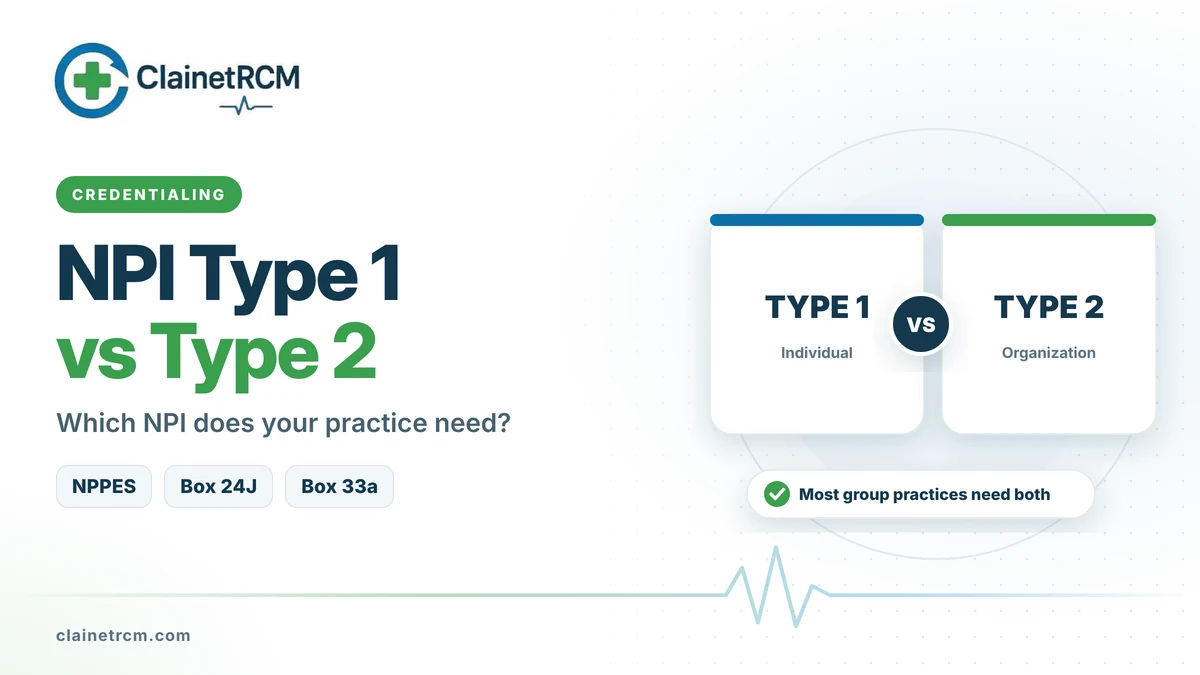
Quick answer: A Type 1 NPI is for individual providers such as physicians, nurse practitioners, PAs, therapists, dentists and chiropractors, including sole proprietors. Each person gets one for life, and it follows them across jobs and states. A Type 2 NPI is for organizations: group practices, professional corporations and LLCs (even with a single provider), hospitals, labs, home health agencies and pharmacies. Most group practices need both, a Type 1 for each clinician and a Type 2 for the entity. Both are free through NPPES.
NPI Type 1 vs Type 2 Compared
| Type 1 (individual NPI) | Type 2 (organizational NPI) | |
|---|---|---|
| Who gets it | Individual providers | Organizations and legal entities |
| Examples | MD, DO, NP, PA, LCSW, PT, DDS, DC | Group practice, PC or PLLC, hospital, lab, home health agency, pharmacy |
| Tied to | The individual (SSN) | The organization (EIN) |
| How many | One per person, for life | One per organization, plus optional subparts |
| Role on claims | Rendering, referring, ordering and attending provider; billing provider only for a sole proprietor | Billing provider and service facility |
| Who applies | The provider or someone they authorize | The organization’s authorized official |
Who Needs a Type 1 NPI
Every individual provider who bills electronically, or who is named on someone else’s claim as a rendering, ordering or referring provider, needs a Type 1 NPI. Residents and practitioners who only order or refer get one too. Because it is tied to the person, a Type 1 NPI never changes when a provider moves to a new state, joins a new group or changes specialties. You update the NPPES record instead.
Who Needs a Type 2 NPI
Any organization that bills for services needs a Type 2 NPI. That includes a multi-provider group, a hospital or lab, and a solo clinician who has formed a professional corporation or LLC. The corporation is a separate legal entity with its own EIN, so it needs its own organizational NPI even if only one person works there.
Sole Proprietor or Corporation? The Deciding Question
- Sole proprietor. You are eligible for one NPI only, a Type 1. You bill under that NPI, using your SSN or an EIN registered to you as a sole proprietor.
- Incorporated solo practice. You keep your Type 1 NPI as the rendering provider, and the PC, PLLC or LLC gets a Type 2 NPI as the billing provider.
- Group practice. The group has a Type 2 NPI; every clinician has a Type 1 NPI and is enrolled with each payer as a member of the group.
If you change from a sole proprietorship to a corporation, plan the switch carefully. The new entity needs its own Type 2 NPI, Medicare enrollment and payer contracts before claims can move to it. Our healthcare business registrations team handles these transitions.
Where Each NPI Goes on a Claim
| Role | CMS-1500 | 837P loop | Which NPI |
|---|---|---|---|
| Billing provider | Box 33a | 2010AA | Type 2 for groups and corporations; Type 1 for a sole proprietor |
| Rendering provider | Box 24J | 2310B (2420A at line level) | Type 1 of the clinician who performed the service |
| Service facility location | Box 32a | 2310C | NPI of the place where the service was performed, when required |
| Referring provider | Box 17b | 2310A | Type 1 of the referring provider |
On the UB-04, form locator 56 holds the billing provider’s NPI and form locator 76 the attending provider’s NPI. When the billing and rendering provider are the same individual, many payers want Box 24J left blank, so check each payer’s companion guide.
How to Apply in NPPES
Apply online through NPPES, the National Plan and Provider Enumeration System, after signing in with a CMS Identity and Access account. A paper application (CMS-10114) is also available, and large organizations can submit bulk files for their providers.
- Type 1 applicants provide their name, SSN, date of birth, license, taxonomy code and practice and mailing addresses.
- Type 2 applicants provide the legal business name and EIN exactly as the IRS lists them, an authorized official, a taxonomy code and addresses.
There is no fee, and online applications are often processed within days. After that, you must update NPPES within 30 days of any change, such as a new practice address.
Taxonomy Codes Matter
Every NPI record lists at least one taxonomy code, and the primary one should match the specialty you bill. Many Medicaid programs and some commercial payers require the taxonomy code on the claim and reject mismatches. A few examples:
- 207Q00000X: Family Medicine (Type 1)
- 2084P0800X: Psychiatry (Type 1)
- 363LF0000X: Family Nurse Practitioner (Type 1)
- 1041C0700X: Clinical Social Worker (Type 1)
- 193200000X: Multi-Specialty Group (Type 2)
- 193400000X: Single Specialty Group (Type 2)
Subpart NPIs
Organizations can request a subpart NPI for a component that bills separately, such as a distinct location, a specialty unit or a separately enrolled service line. Hospitals and large groups use them most. Ask each payer how it wants subparts enrolled before you create one, because a subpart NPI that a payer has not loaded will reject.
NPI Mistakes That Cause Rejections
- A Type 1 NPI in Box 33a for a claim that should bill under the group.
- The group’s Type 2 NPI in Box 24J as the rendering provider.
- An NPI and TIN pair that does not match the payer’s enrollment record.
- Billing under a new entity whose NPI is not yet enrolled with the payer.
- Outdated NPPES addresses or the wrong primary taxonomy.
These errors usually show up as front-end rejections. Our guide to clearinghouse rejections explains how to clear them.
Frequently Asked Questions
Yes, when the provider owns an incorporated practice. The individual keeps a Type 1 NPI, and the corporation gets its own Type 2 NPI.
No. A sole proprietor is eligible for one NPI, a Type 1. Forming a corporation or LLC is what makes the practice eligible for a Type 2.
No. A Type 1 NPI stays with you for life. Update your NPPES record within 30 days instead.
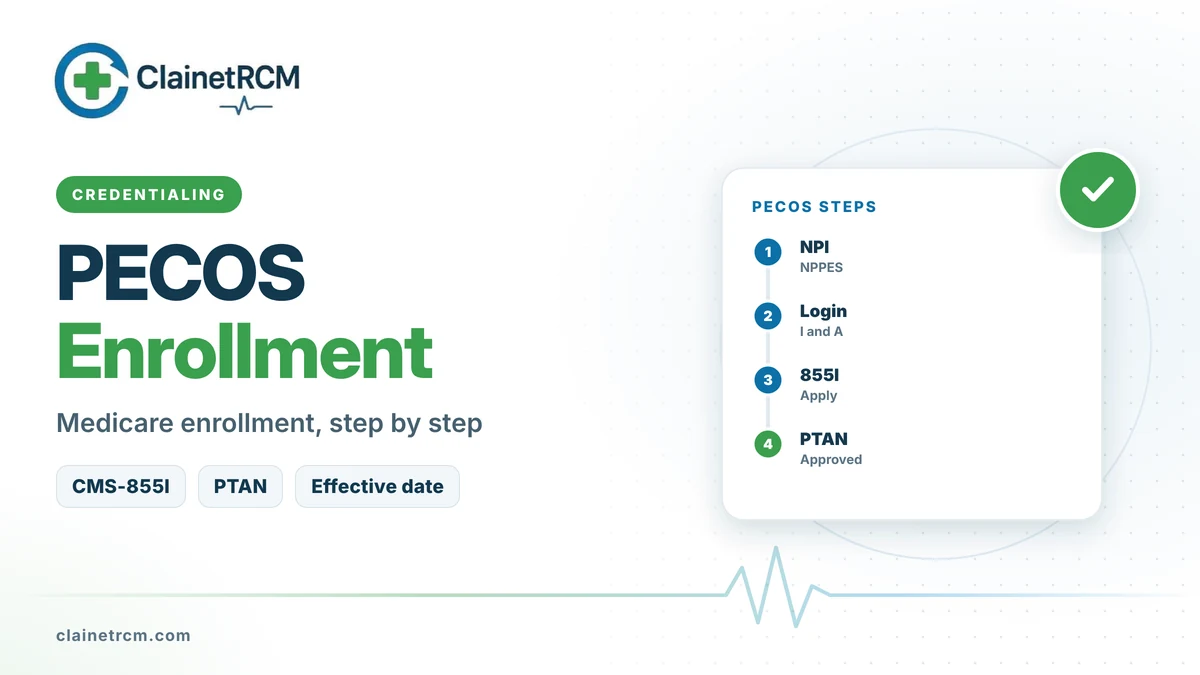
No. The NPI is a national identifier. Medicare issues a PTAN and Medicaid programs issue their own provider IDs after enrollment.
The Type 1 NPI of the individual who rendered the service.
Nothing. Applying through NPPES is free.
Final Thoughts
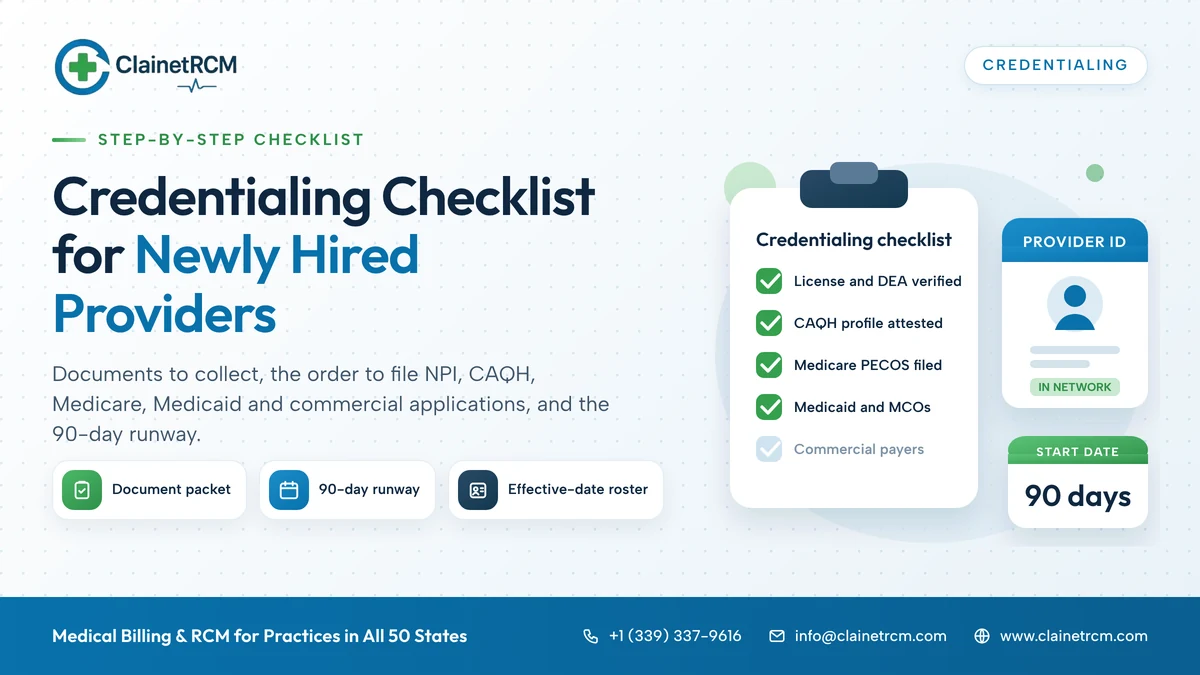
The NPI Type 1 vs Type 2 decision comes down to one question: who is billing, the individual or an organization? Get that right, keep NPPES current and match every NPI to the right claim field, and a whole category of rejections disappears. For the rest of your setup, see our credentialing checklist for new providers and our PECOS enrollment guide.
Set Up Your Practice the Right Way
We obtain and update NPIs, align them with your TIN and payer enrollments, and make sure every claim carries the right billing and rendering provider.
Get Registration Help
Written by
ClainetRCM Billing Team
ClainetRCM is a Boston-based revenue cycle management company specializing in medical billing, coding, credentialing and denial management for healthcare providers across all 50 states. Our AAPC and AHIMA certified team works inside your existing EHR, files claims within 24 to 48 hours and reviews every AR bucket on a 14-day cycle.