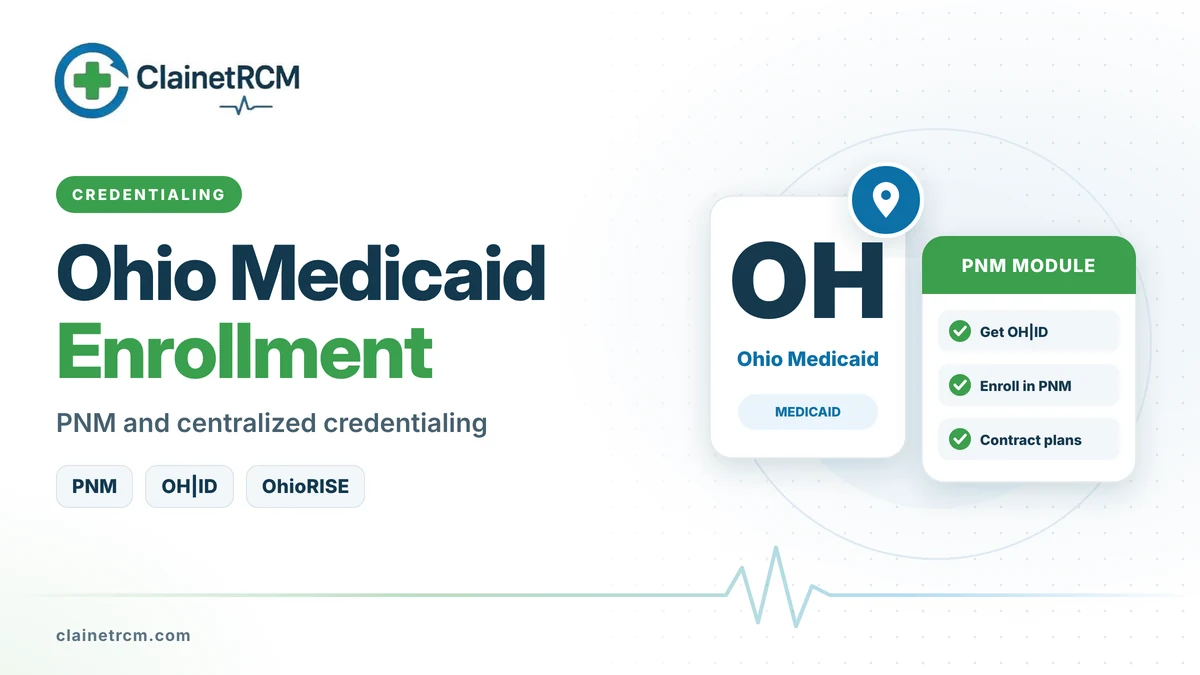
Ohio Medicaid provider enrollment works differently from most states. The Ohio Department of Medicaid (ODM) handles enrollment, revalidation and credentialing in a single system, the Provider Network Management (PNM) module, so providers are credentialed once by the state instead of separately by each managed care plan. You still contract with each plan, but the paperwork is far simpler when the PNM application is done right.
Quick answer: Create an OH|ID account, sign in to the PNM module and submit your enrollment application online, because Ohio does not accept paper applications. Providers subject to credentialing complete it through ODM’s centralized credentialing process in the same system. After approval, contract with the Next Generation managed care plans, OhioRISE and MyCare Ohio plans you want to join. Federal rules let a plan sign an agreement while your state enrollment is pending for up to 120 days, but enrollment must be completed for you to stay in network.
What the PNM Module Does
- Single entry point. Since October 1, 2022, the PNM module has handled provider enrollment, revalidation, credentialing and self-service updates. It replaced the old MITS provider portal.
- OH|ID login. Every user needs an OH|ID account to access PNM and complete administrative tasks.
- Provider directory. PNM feeds a statewide directory that shows each provider’s managed care plan affiliations.
- Requirement for managed care. ODM requires every provider who serves Medicaid managed care members to be enrolled in PNM.
Centralized Credentialing in Ohio
Before centralized credentialing, each managed care plan credentialed providers separately. Now providers subject to credentialing are credentialed and recredentialed once at the state level, and the plans rely on ODM’s decision. The process covers Medicaid managed care plans, OhioRISE and MyCare Ohio, but it does not replace contracting: you still sign an agreement with each plan.
| Step | Who does it | What you provide |
|---|---|---|
| Enrollment | Provider, in PNM | Application, NPI, license and ownership disclosures |
| Credentialing | ODM, through PNM | Education, training, work history, malpractice coverage and attestation |
| Contracting | Each managed care plan | Signed agreement and rates |
| Recredentialing | ODM, through PNM | Updated information and documents on schedule |
Ohio Medicaid Provider Enrollment Step by Step
- Create your OH|ID. Each staff member who will work in PNM needs a personal account linked to the provider record.
- Confirm NPPES data. The name, address and taxonomy in PNM should match NPPES and the license.
- Start the PNM application. Select the provider type and specialty, enter locations and add ownership and managing employee information.
- Complete the credentialing questions and documents. Providers subject to credentialing answer the credentialing section and upload supporting documents as part of the same application.
- Pay any required fee. Institutional provider types owe the federal application fee ($750 for 2026).
- Respond to requests. ODM may ask for corrections, and delays in answering push back approval.
- Contract with plans. Send contract requests to each plan you want to join once enrollment is approved or pending.
Documents to Have Ready
Having these items ready before you start keeps the PNM application moving:
- An OH|ID for each person who will work in PNM
- NPI and a matching NPPES record
- Ohio license and, for prescribers, DEA registration
- Education, training and board certification details
- A current malpractice insurance face sheet
- Work history with explanations for any gaps
- Tax ID, ownership and managing employee information for organizations
Next Generation Plans, OhioRISE and MyCare Ohio
Ohio launched its Next Generation managed care program on February 1, 2023. The plans are AmeriHealth Caritas Ohio, Anthem Blue Cross and Blue Shield, Buckeye Health Plan, CareSource, Humana Healthy Horizons in Ohio, Molina Healthcare of Ohio and UnitedHealthcare Community Plan of Ohio.
- OhioRISE is a specialized behavioral health plan for children and youth with complex needs, administered by Aetna Better Health of Ohio.
- MyCare Ohio serves members who have both Medicare and Medicaid, and contracting for those plans is separate from the Medicaid-only plans.
- Prior authorization for managed care members goes directly to the member’s plan, not to ODM.
Because credentialing happens at the state level, plan contracting usually moves faster in Ohio than in states where every plan credentials on its own.
Revalidation and Recredentialing
Federal rules require ODM to complete revalidation for every provider at least every five years, and recredentialing runs on its own cycle through PNM. Keep licenses, malpractice coverage and practice locations up to date in PNM, and respond to revalidation notices before the due date to avoid a gap in enrollment.
Common Mistakes to Avoid
- Shared OH|ID logins. Each user needs their own account; shared logins create access and audit problems.
- Assuming credentialing means in network. You are not in network until each plan signs a contract.
- Skipping PNM for managed-care-only providers. Managed care participation still requires PNM enrollment.
- Mismatched locations. Locations in PNM, plan contracts and claims should match.
- Missed revalidation. An inactive enrollment stops payment from ODM and from the plans.
Frequently Asked Questions
PNM, the Provider Network Management module, is ODM’s online system for Medicaid provider enrollment, revalidation, centralized credentialing and provider data updates. It replaced the MITS provider portal in October 2022.
Not separately for Medicaid. ODM credentials and recredentials providers once at the state level, and the plans rely on that decision. Each plan still contracts with you on its own.
Federal rules let a plan sign a network agreement while your enrollment is pending for up to 120 days. If enrollment is not completed in that window, the plan must end the agreement.
No. Enrollment applications must be submitted electronically through PNM.
That depends on the members you serve. Most providers contract with several Next Generation plans; behavioral health providers serving youth may also join OhioRISE, and providers serving dual-eligible members may join MyCare Ohio plans.
Final Thoughts
Ohio Medicaid provider enrollment rewards getting the PNM application right the first time, because it covers enrollment and credentialing together. Learn how we support Ohio practices on our Ohio page, compare the process with our Texas Medicaid enrollment guide, or let our credentialing team manage PNM and plan contracting for you.
Enroll and Credential Once, Then Contract With Every Ohio Plan
We manage PNM applications, centralized credentialing files and Next Generation plan contracts so your Ohio providers can see Medicaid members without delays.
Start Ohio Enrollment
Written by
ClainetRCM Billing Team
ClainetRCM is a Boston-based revenue cycle management company specializing in medical billing, coding, credentialing and denial management for healthcare providers across all 50 states. Our AAPC and AHIMA certified team works inside your existing EHR, files claims within 24 to 48 hours and reviews every AR bucket on a 14-day cycle.