CPT code 99212 is the level 2 office visit for an established patient. It is meant for quick, simple encounters, and it pays accordingly. Most practices should not bill it often. When 99212 shows up a lot in your claims, the usual cause is not a run of simple visits but undercoding of visits that actually supported 99213 or higher.
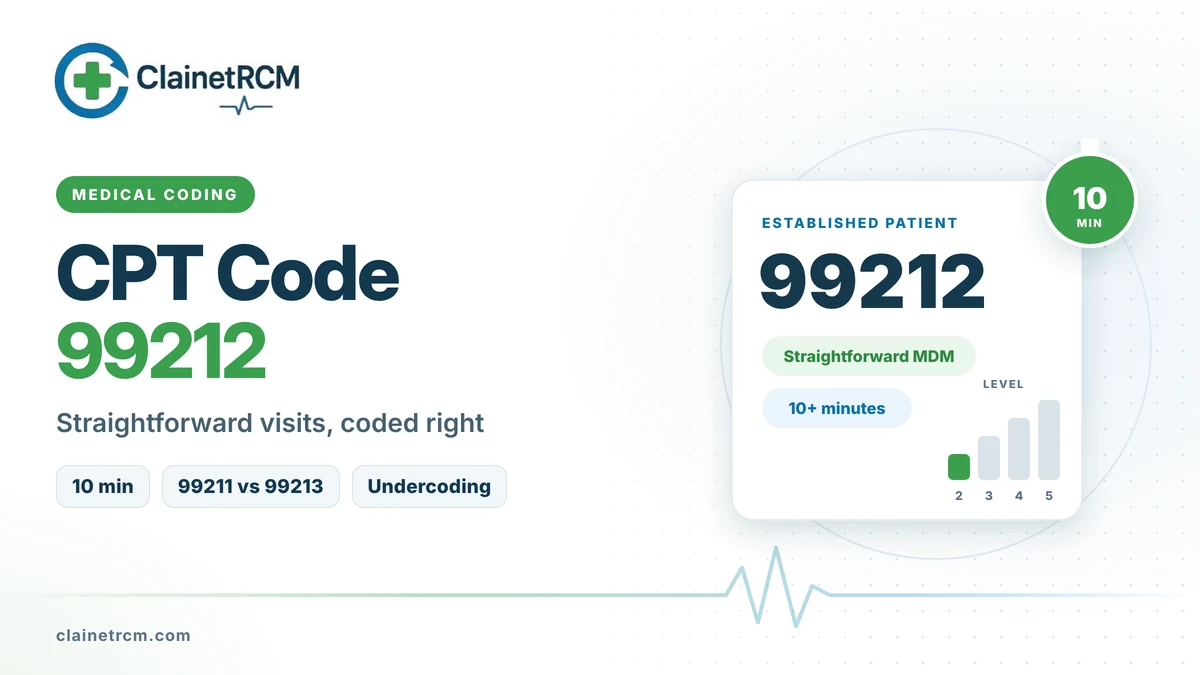
Quick answer: CPT code 99212 is supported by straightforward medical decision making (MDM) or at least 10 minutes of total practitioner time on the date of the encounter. The 2026 Medicare national rate is $59.45 in the office and $31.06 in a facility. A typical 99212 involves one self-limited or minor problem with little or no data review and minimal risk.
CPT Code 99212 at a Glance
| Item | Detail |
|---|---|
| Descriptor | Office or other outpatient visit for an established patient, requiring a medically appropriate history and/or examination and straightforward medical decision making |
| Time threshold | 10 minutes of total time on the date of the encounter, met or exceeded |
| 2026 Medicare national rate | $59.45 non-facility, $31.06 facility |
| Who performs it | Physician or other qualified health care professional |
| Lower level | 99211, which does not require a physician or QHP |
| Higher level | 99213, low MDM or 20 minutes |
What CPT Code 99212 Requires
Like all office visits since 2021, 99212 is selected by MDM or time. The note must still show a medically appropriate history and exam.
Straightforward MDM means meeting two of these three elements:
| MDM element | Straightforward level |
|---|---|
| Problems addressed | One self-limited or minor problem |
| Data reviewed and analyzed | Minimal or none |
| Risk of patient management | Minimal risk of morbidity from additional testing or treatment |
A self-limited or minor problem is one that runs a definite course, is transient and is unlikely to permanently change health status, such as a simple cold or a minor skin irritation.
On time, 99212 requires at least 10 minutes of the billing practitioner’s total time on the date of the encounter. Time includes record review, the exam, counseling, ordering and documentation, but not clinical staff time.
Visits That Fit 99212
- A recheck of a minor skin abrasion that is healing and needs no further treatment
- An uncomplicated cold with no systemic symptoms, managed with rest and over-the-counter advice
- A brief visit for a minor rash treated with a non-prescription cream
- A follow-up for an insect bite that is resolving
Watch what happens when the visit includes a prescription. Prescription drug management is moderate risk. One stable chronic illness, such as controlled hypothyroidism, is a low complexity problem. A refill visit with one stable chronic illness and a documented prescription decision therefore has two elements at low or higher, which is low MDM, a 99213, not a 99212.
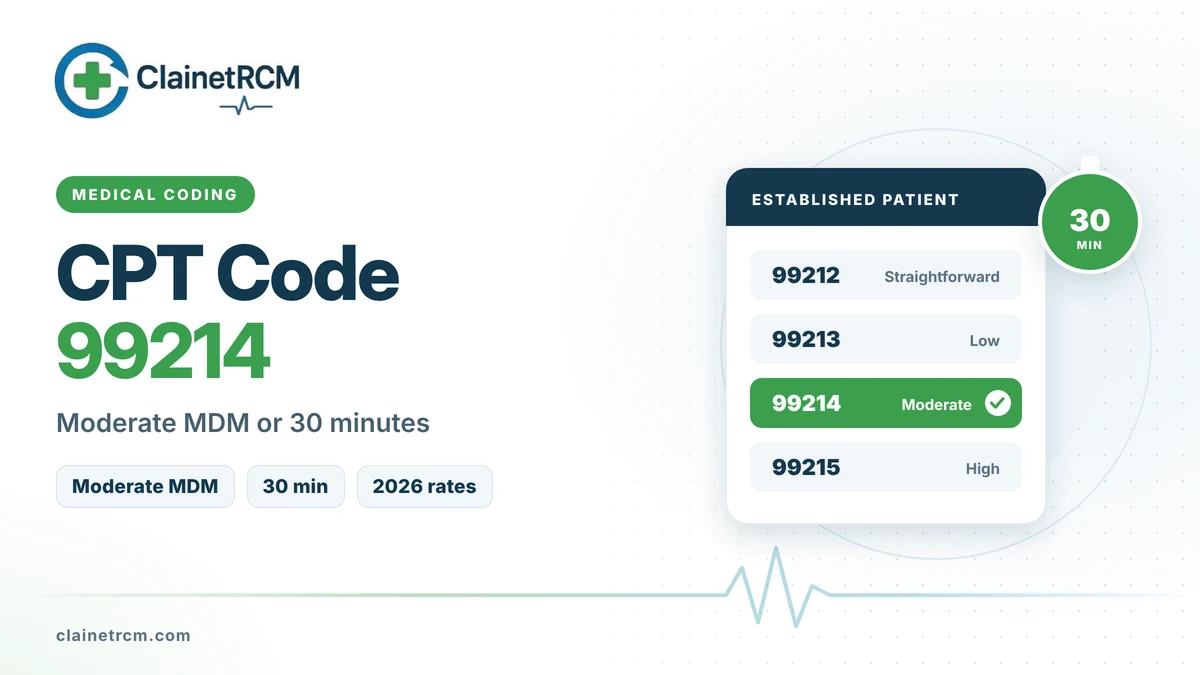
99211 vs 99212 vs 99213
| Code | Who performs it | MDM or time | 2026 Medicare national (office) |
|---|---|---|---|
| 99211 | Usually clinical staff under supervision | No MDM or time requirement | $24.38 |
| 99212 | Physician or QHP | Straightforward MDM or 10 minutes | $59.45 |
| 99213 | Physician or QHP | Low MDM or 20 minutes | $95.19 |
99211 is the nurse visit: a blood pressure check, an injection visit with an assessment or a wound check performed by clinical staff. In Medicare, it is billed incident-to the supervising practitioner and must meet incident-to rules, including direct supervision in the office.
99212 needs the physician or QHP to evaluate the patient.
99213 begins as soon as the visit reaches low complexity, for example two self-limited problems, one stable chronic illness or one acute uncomplicated illness, combined with low data or low risk.
99212 Documentation Example
A short note can fully support 99212 when it shows the problem, the evaluation and the plan:
- Chief complaint: “Recheck of scrape on left forearm from a fall last week.”
- History: “Healing well. No fever, drainage or increasing redness. Using over-the-counter antibiotic ointment.”
- Exam: “2 cm superficial abrasion with healthy granulation tissue. No erythema or discharge.”
- Assessment and plan: “Healing abrasion, no signs of infection. Continue wound care at home. Return if redness or drainage develops.”
The problem is minor, no data were reviewed and the plan carries minimal risk, so the visit is straightforward MDM. If the clinician had also reviewed outside urgent care notes, ordered a culture and prescribed an oral antibiotic, the same visit would move up to 99213 or higher.
The Hidden Cost of Undercoding
The difference between 99212 and 99213 is $35.74 per visit at 2026 national Medicare rates. A clinician who bills 99212 for 10 visits a week that really supported 99213 leaves more than $18,000 a year on the table from Medicare rates alone.
Common reasons for undercoding:
- The EHR suggests a level based on the old history and exam rules
- The clinician forgets that prescription drug management is moderate risk
- Time is not recorded, so a 22-minute visit is billed on MDM alone
- Fear of audits pushes every level down by one
Undercoding is also a compliance problem. Coding should match the documentation in both directions.
2026 Payment and Add-Ons
The 2026 national Medicare payment for 99212 is $59.45 in a non-facility setting, up 8.1% from 2025, and $31.06 in a facility setting.
G2211 can be added to 99212 when you are the continuing focal point of the patient’s care, or you manage a serious or complex condition over time. The add-on is about the ongoing relationship, not the complexity of that day’s visit, so a brief visit can still qualify. It pays $17.37 nationally in 2026, and in 2027 it becomes modifier B1, which adds 16% to the E/M payment. See our G2211 guide.
Telehealth and Other Edge Cases
- Telehealth: 99212 can be billed for an audio-video visit. For Medicare, use POS 10 when the patient is at home and POS 02 for other locations.
- Post-operative visits: a routine follow-up inside a surgical global period is not billed as 99212. It is included in the surgery payment.
- Same-day procedures: if a minor procedure is the reason for the visit, the decision to do it is included in the procedure. Bill 99212 with modifier 25 only when there is a separate, significant problem.
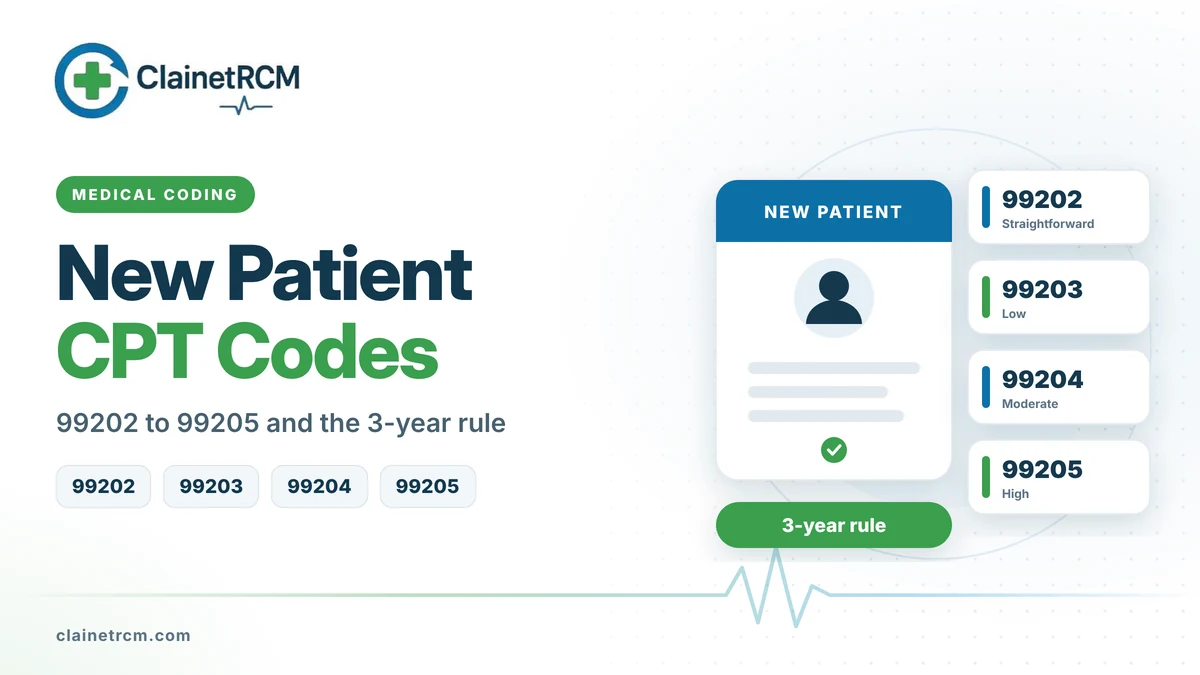
- New patients: 99212 is for established patients only. The new patient equivalent is 99202. See our new patient CPT codes guide.
Frequently Asked Questions
CPT code 99212 is an office or outpatient visit for an established patient that requires a medically appropriate history and exam and straightforward medical decision making, or at least 10 minutes of total time on the date of the visit.
The national rate is $59.45 in a non-facility setting and $31.06 in a facility setting, before geographic adjustment.
99211 is usually performed by clinical staff and has no MDM or time requirement. 99212 requires a physician or other qualified health care professional and straightforward MDM or 10 minutes.
Usually not. A refill involves prescription drug management, which is moderate risk. Combined with a stable chronic illness, that is low MDM, which supports 99213.
The note must include a medically appropriate history and/or examination, as determined by the treating clinician. The extent of the exam no longer sets the level, but it should fit the problem being evaluated.
Since 2024, CPT uses a single threshold instead of a range: 10 minutes must be met or exceeded for 99212. Once total time reaches 20 minutes, the visit supports 99213.
Final Thoughts
CPT code 99212 has a place for truly simple visits, but a practice that bills it often should look closely at why. In most audits, the answer is undercoding, not simplicity. Our medical coding team reviews E/M levels against your documentation so every visit is billed at the level it supports, no higher and no lower.
Stop Leaving Money in Undercoded Visits
Our coders compare your documentation with the E/M level billed, so simple visits stay simple and real work gets paid at the right level.
Get a Free E/M Audit
Written by
ClainetRCM Billing Team
ClainetRCM is a Boston-based revenue cycle management company specializing in medical billing, coding, credentialing and denial management for healthcare providers across all 50 states. Our AAPC and AHIMA certified team works inside your existing EHR, files claims within 24 to 48 hours and reviews every AR bucket on a 14-day cycle.