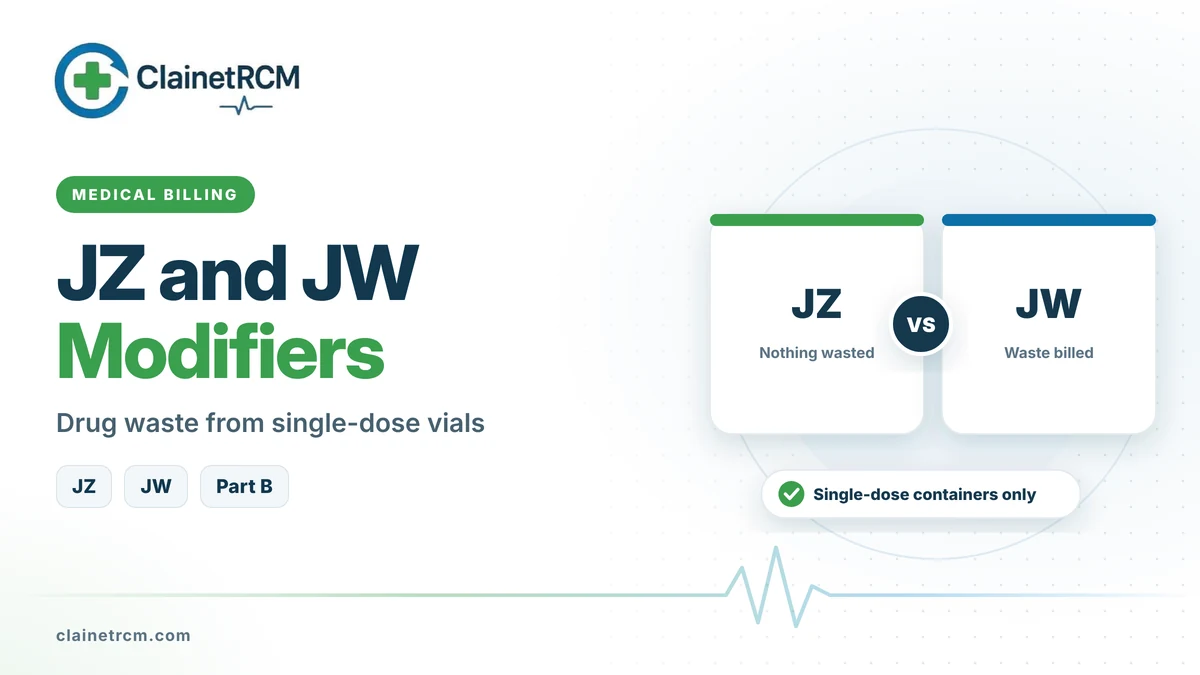
The JZ modifier tells Medicare that no amount of a drug from a single-dose container was discarded. Its partner, the JW modifier, reports the amount that was discarded. Since July 1, 2023, Medicare has required one or the other on every claim line for a separately payable Part B drug supplied in a single-dose container, and claims without them can be returned. The data also drives manufacturer refunds, so accuracy matters beyond payment.
Quick answer: Bill the administered amount of a single-dose container drug on one line. If nothing was discarded, add the JZ modifier to that line. If part of the vial was discarded, bill the discarded amount on a separate line with the JW modifier and document the discarded amount in the record. The rules apply to separately payable Medicare Part B drugs from single-dose containers or single-use packages, including in hospital outpatient departments and critical access hospitals. They do not apply to multiple-dose vials or to drugs that are not separately payable.
JZ Modifier and JW Modifier at a Glance
| Modifier | Meaning | When to use it |
|---|---|---|
| JZ | Zero drug amount discarded | The full contents of the single-dose container were administered |
| JW | Drug amount discarded or not administered to any patient | Part of a single-dose container was discarded |
When the Modifiers Are Required
- Single-dose containers or single-use packages, as described by the FDA-approved labeling
- Separately payable Part B drugs, whether billed by physician offices, hospital outpatient departments or critical access hospitals
- Drugs excluded from refunds still count. Medicare requires the modifiers even for single-dose container drugs that are not subject to manufacturer refunds, such as multiple-source drugs, radiopharmaceuticals and imaging agents.
When They Do Not Apply
- Multiple-dose vials, which are meant to be used for more than one dose
- Packaged drugs that are not separately payable, such as many drugs in the hospital outpatient setting
- Rural health clinics and federally qualified health centers
- Drugs billed under Part D
Other payers may adopt the rules. Several Medicare Advantage and Medicaid plans now require JW and JZ on applicable drug lines, so check each payer’s policy.
How to Bill Drug Waste With JW
- Calculate the administered amount in billing units and report it on the first line.
- Calculate the discarded amount from the same single-dose container and report it on a second line with JW.
- Make sure the totals tie to whole vials. The administered and discarded units together should equal the amount in the containers used.
- Document the waste in the medical record, including the amount discarded.
Do not use JW for overfill, for drug that was not discarded or for amounts left in a multiple-dose vial.
Examples
| Scenario | Claim lines |
|---|---|
| Rituximab (J9312, per 10 mg): 450 mg given from one 500 mg single-dose vial | J9312 ×45; J9312-JW ×5 |
| Pembrolizumab (J9271, per 1 mg): 200 mg given from two 100 mg vials, nothing left | J9271-JZ ×200 |
| Drug from a multiple-dose vial | No JW or JZ |
| Drug packaged into a hospital outpatient payment | No JW or JZ |
Why the Data Matters: Discarded Drug Refunds
Under the Infrastructure Investment and Jobs Act, manufacturers of certain single-dose container drugs must refund Medicare when discarded amounts exceed a set percentage, generally 10%. CMS calculates those refunds from JW and JZ claim data. Inaccurate modifiers can distort refund calculations, and both over-reported and under-reported waste invite scrutiny.
Skin Substitutes in 2026
CMS’s updated JW and JZ FAQ clarifies that, beginning in 2026, discarded amounts of skin substitute products are not separately paid. Practices that bill skin substitutes should review the 2026 payment rules and their documentation rather than relying on prior JW billing habits.
Audit Risks and Best Practices
- Missing modifiers. Lines for single-dose container drugs without JW or JZ can be returned or denied.
- Unsupported waste. Waste billed with JW but not documented is an overpayment risk.
- Mismatched units. Administered plus discarded units that do not match vial sizes signal errors.
- Wrong containers. Billing JW for multiple-dose vials is incorrect.
- Best practice: record the NDC, vial size, dose given and amount discarded in the administration record at the time of preparation, and build EHR prompts that require one of the two modifiers on applicable drugs.
- Train staff: nurses and pharmacists who prepare drugs should know which products come in single-dose containers.
Building JW and JZ Into Your Workflow
- Map every drug. Flag which drugs in your charge master come in single-dose containers and their vial sizes.
- Capture the details at administration. Record the NDC, vial size, dose given and any amount discarded in the administration record.
- Use EHR prompts. Require a JW or JZ selection before a single-dose drug charge can be dropped.
- Reconcile units. Check that administered plus discarded units match whole vials before claims go out.
- Audit regularly. Review a sample of drug claims each month for missing modifiers and unsupported waste.
Frequently Asked Questions
The JZ modifier means zero drug amount was discarded. It is added to the drug line when the entire contents of a single-dose container were administered.
Since July 1, 2023, Medicare has required JZ on separately payable Part B drugs from single-dose containers when no drug was discarded.
No. The modifiers apply only to drugs supplied in single-dose containers or single-use packages.
Bill the administered amount on one line and the discarded amount on a separate line with the JW modifier, and document the discarded amount in the medical record.
Some do. Many Medicare Advantage and Medicaid plans have adopted the requirement, so check each payer’s policy.
Final Thoughts
The JZ modifier and JW modifier are small additions to a claim line, but they control payment, refunds and audit exposure for single-dose drugs. Learn how we support infusion and cancer care on our hematology and oncology billing page, or review unlisted drug billing in our HCPCS code J3490 guide.
Keep Drug Claims Compliant and Paid
Our coders check every single-dose drug line for the right units and JW or JZ modifier, so your claims pass edits and hold up in audits.
Get Drug Billing Help
Written by
ClainetRCM Billing Team
ClainetRCM is a Boston-based revenue cycle management company specializing in medical billing, coding, credentialing and denial management for healthcare providers across all 50 states. Our AAPC and AHIMA certified team works inside your existing EHR, files claims within 24 to 48 hours and reviews every AR bucket on a 14-day cycle.