Maryland's Medicaid Health Home program pays behavioral health providers a monthly rate to coordinate the whole-person care of people with serious mental illness, serious emotional disturbance or opioid use disorder. The money is real, but the billing rules are unusual: one intake payment, one monthly payment that depends on documenting two services from six defined categories, encounter codes that pay nothing on their own, and a 30-day reporting rule with a penalty attached.
This guide sets out the Maryland Medicaid Health Home fee schedule as it stands in 2026, the rate history behind it, the W-codes and modifiers, the service and reporting conditions that make a claim payable, the staffing minimums, and the changes since the program moved to Carelon Behavioral Health. It is written for psychiatric rehabilitation programs, mobile treatment providers and opioid treatment programs, and for the billing teams that support them.
Last updated: October 2026. Rates are taken from the Maryland Department of Health fee schedules; verify against the current Carelon Behavioral Health provider fee schedule before billing.
Key takeaways
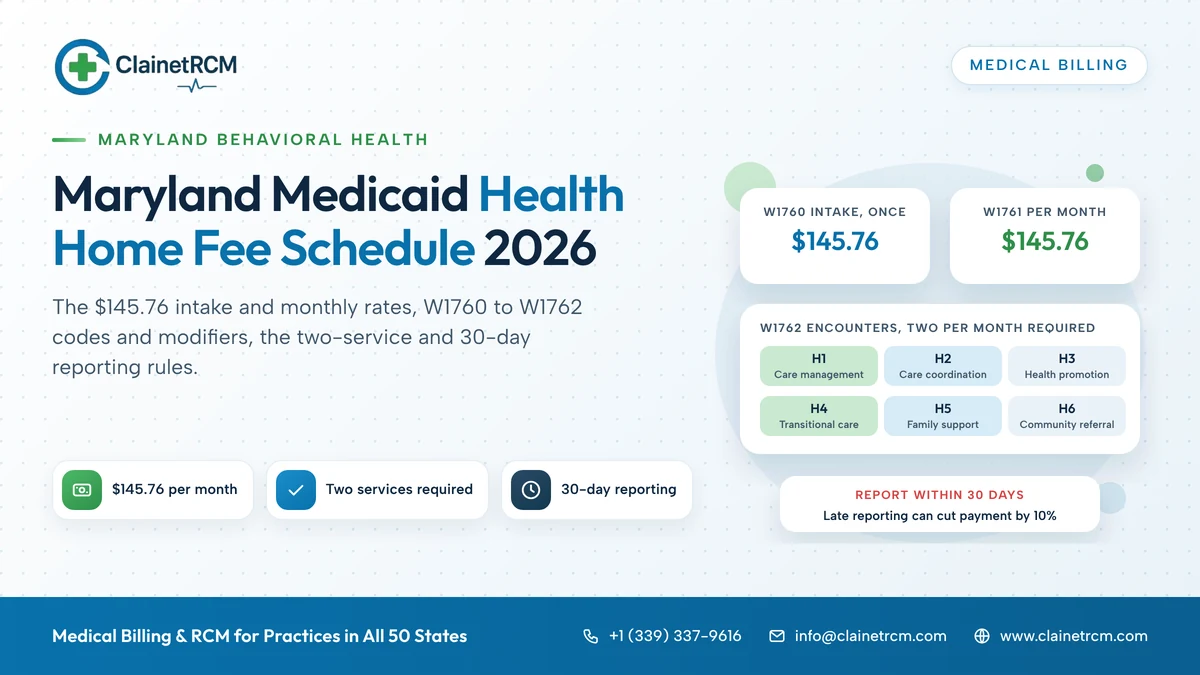
- The latest published Health Home rate is $145.76 per participant for the intake assessment (W1760, once per participant) and $145.76 per participant per month for monthly services (W1761), effective July 1, 2024 and carried on the January 1, 2025 schedule.
- The monthly payment requires at least two documented Health Home services in the month, reported as W1762 encounter codes with modifiers H1 through H6. The encounter codes themselves are non-billable; without two of them, W1761 does not pay.
- Services must be reported within 30 days of the end of the month they were delivered; late reporting can cut the payment by 10 percent. Claims must be submitted within 12 months of the date of service.
- Only Medicaid-enrolled psychiatric rehabilitation programs, mobile treatment programs and opioid treatment programs can be Health Homes, and a participant can only receive Health Home services from their own PRP, mobile treatment or OTP provider.
- Since January 1, 2025, Health Home services are administered and paid through Carelon Behavioral Health, Maryland's behavioral health administrative services organization, with authorizations every six months.
What the Maryland Health Home Program Is
Maryland runs a single statewide Health Home model under Section 2703 of the Affordable Care Act, approved by CMS as state plan amendment MD-13-15 and in operation since October 1, 2013. It serves adults with serious mental illness, children with serious emotional disturbance, and individuals with opioid use disorder who are at risk for another chronic condition because of current or past tobacco, alcohol or other non-opioid substance use. Participation is opt-in for the participant, and the program is governed by COMAR 10.09.33.
Three provider types may be Health Homes: psychiatric rehabilitation programs (PRPs), mobile treatment (MT) programs and opioid treatment programs (OTPs). A provider must already be enrolled in Maryland Medicaid through ePREP before applying to the Maryland Department of Health to add the Health Home designation, and under COMAR 10.09.33.08, a participant may not receive Health Home services from a provider that is not their own PRP, mobile treatment or OTP provider. For practices in the state, our Maryland medical billing page covers the payers and programs we work with.
The 2026 Fee Schedule: Codes, Modifiers and Rates
| Code | Modifier | Description | Unit | Rate | Rule |
|---|---|---|---|---|---|
| W1760 | None | Health Home intake assessment and enrollment | Per participant, once | $145.76 | Billable once per participant; the date of service is the date the intake was submitted to the state system, not the assessment date; cannot count as one of the two monthly services |
| W1761 | None | Health Home monthly services | Per participant per month | $145.76 | Payable only when two services from the six core areas were delivered and reported in the month; billable once per month, starting the first day of the following month |
| W1762 | H1 | Comprehensive care management (encounter) | Per service | Non-billable | Reported to document the monthly service requirement |
| W1762 | H2 | Care coordination (encounter) | Per service | Non-billable | Same |
| W1762 | H3 | Health promotion (encounter) | Per service | Non-billable | Same |
| W1762 | H4 | Comprehensive transitional care (encounter) | Per service | Non-billable | Same |
| W1762 | H5 | Individual and family support (encounter) | Per service | Non-billable | Same |
| W1762 | H6 | Referral to community and social support services (encounter) | Per service | Non-billable | Same |
Place of service codes on the schedule are OTP 32 (also 58, 11, 15, 49), PRP (11, 49, 52, 15) and mobile treatment (11, 15, 49). Claims are submitted electronically as HIPAA 837 professional claims, or on paper on the CMS-1500, to the ASO. The $145.76 rate appears on the Maryland Department of Health's "FY25 Health Home Fee Schedule (Effective 07/01/2024)" and again on the schedule effective January 1, 2025, which is the most recent Health Home schedule we could locate as of October 2026.
About the "2026 rate." We found no Maryland Health Home fee schedule dated July 1, 2025 or January 1, 2026, and CMS's March 2026 state profile lists no Health Home rate amendment after MD-24-0014 (the 3 percent increase effective July 1, 2024). Treat $145.76 as the current published rate and check Carelon's Maryland provider fee schedules before each billing cycle; if a later schedule has posted, it supersedes this table. Older guides still showing $98.87 or $106.46 are years out of date.
How the Rate Got Here
| Effective date | Monthly rate (W1761) | Change | Authority |
|---|---|---|---|
| Before July 1, 2016 | $98.87 | Original rate | COMAR 10.09.33 |
| July 1, 2016 | $100.85 | 2 percent increase | Md. Register notice 16-217-P |
| July 1, 2017 | $102.86 | 2 percent increase | Md. Register notice 17-256-P |
| January 1, 2021 | Rate increased | 3.5 percent increase | SPA MD-21-0005 |
| July 1, 2022 | $127.21 | FY2023 rate | COMAR 10.09.33.09 |
| July 1, 2023 | $131.03 | 3 percent increase | SPA MD-23-0017; COMAR 10.09.33.09 |
| January 1, 2024 | Rate increased | 8 percent increase | SPA MD-24-0006 |
| July 1, 2024 | $145.76 | 3 percent increase | SPA MD-24-0014; FY25 public notice |
| January 1, 2025 | $145.76 | No change; schedule reissued for the Carelon transition | FY2025 PBHS Health Home fee schedule |
The intake payment (W1760) was added by SPA MD-20-0006, effective July 1, 2020, and has tracked the monthly rate since. For a Health Home with 125 enrollees, the difference between the 2017 rate and today's rate is roughly $64,000 a year in monthly payments alone, which is why providers that let enrollment lapse or under-document services leave more on the table than they realize.
The Six Core Health Home Services
Every monthly payment rests on two documented services from these categories, as defined in Maryland's Health Home provider manual and encoded as the W1762 modifiers.
| Modifier | Service | What counts |
|---|---|---|
| H1 | Comprehensive care management | Developing and updating a whole-person care plan with the participant and family; coordinating the Health Home team |
| H2 | Care coordination | Linking the participant to somatic, behavioral and social services, scheduling, and following up on referrals; EPSDT tracking for children |
| H3 | Health promotion | Teaching self-management of chronic and somatic conditions: lifestyle counseling, medication review, prevention |
| H4 | Comprehensive transitional care | Reducing avoidable admissions and readmissions; responding to CRISP hospital encounter alerts; follow-up contact within two business days of discharge |
| H5 | Individual and family support | Supporting medication adherence, health literacy and self-advocacy for the participant and family |
| H6 | Referral to community and social support services | Housing, benefits, legal, peer support and other community referrals, with follow-through |
Two practical notes. The intake assessment (W1760) does not count toward the two monthly services, so a participant enrolled on the 25th of the month still needs two separate services before the first W1761 can be billed for that month. And two services of the same type count, as long as each is a distinct, documented encounter; the requirement is two services, not two categories.
Billing Rules That Decide Whether the Claim Pays
- Two services, documented, in the month. Under COMAR 10.09.33.08, the Department may not pay the monthly rate unless the participant received at least two Health Home services in the month and they were documented in the state system. Under Carelon, W1761 claims without the two corresponding W1762 encounters for that month are not paid.
- Report within 30 days. Services must be reported within 30 days of the end of the month in which they were delivered, and the provider manual warns that late submission may result in a 10 percent reduction in payment. COMAR 10.09.33.09 likewise requires the payment request within 30 days from the end of the month.
- Timely filing. Claims not submitted within 12 months of the date of service are not paid.
- One monthly claim. W1761 may not be billed more than once per participant per month, and is submitted starting the first day of the following month.
- Authorization. Since the Carelon transition, authorization is requested at intake for an initial six months and renewed every six months, with clinical and social outcome measures reported each time.
- Provider identity. The billing provider must be the participant's own PRP, mobile treatment or OTP provider with an active Health Home designation.
- Clearinghouse routing. Electronic claims to the Maryland public behavioral health system use Carelon's submitter ID (BHOMD); confirm the payer setup in your practice management system after any clearinghouse change.
Denials on Health Home claims almost always trace to the encounter record rather than the claim: a missing second W1762, an encounter reported after the 30-day window, an intake dated to the assessment rather than the submission, or an authorization that lapsed at the six-month mark. Our mental health billing and substance abuse treatment billing teams work these programs in Maryland and reconcile the encounter data against the claim before submission.
The 2025 Transition to Carelon Behavioral Health
On January 1, 2025, Carelon Behavioral Health became the administrative services organization for Maryland's public behavioral health system, and Health Home services for dates of service on or after that date moved from the eMedicaid and eClaims systems into Carelon's platform. Services through December 31, 2024 remained in eMedicaid. State plan amendment MD-25-0012, effective July 1, 2025 and approved in December 2025, updated the Health Home SPA pages to reference the ASO management system instead of eMedicaid. For billing teams, the practical changes were new portal workflows for intake and encounter reporting, the six-month authorization cycle, and the linkage rule that W1761 pays only when the two W1762 encounters are on file for the month.
Staffing and Program Requirements
Maryland ties the rate to a staffing model, and the Department can audit against it.
| Role | Minimum | Notes |
|---|---|---|
| Health Home director | 0.5 FTE per 125 enrollees | Dedicated at a minimum of 0.5 FTE |
| Health Home care manager | 0.5 FTE per 125 enrollees | The initial care manager role must be filled by a registered nurse or nurse practitioner |
| Physician or nurse practitioner consultant | 1.5 hours per enrollee per 12 months | Provides somatic consultation to the team |
| Reporting | Monthly, within 30 days of month end | Encounters and outcome measures through the ASO system; CRISP enrollment for hospital alerts |
Providers applying for the designation submit the Health Home provider application to the Maryland Department of Health after Medicaid enrollment is complete. Groups adding a Health Home line of business should confirm the Medicaid enrollment and provider type records are current before applying, because the designation is added to the existing enrollment.
What It Means for a Provider's Revenue
At $145.76 per participant per month, a Health Home with 125 active participants bills about $18,220 a month, or roughly $218,600 a year, plus $145.76 for each new intake. The program's economics therefore depend on three operational numbers: the share of enrolled participants who actually receive two documented services each month, the share of encounters reported inside the 30-day window, and the intake-to-enrollment rate. A Health Home that enrolls 125 but documents two services for only 95 of them each month is leaving about $52,000 a year uncollected.
Those are process problems, and they are fixable: encounter documentation templates mapped to H1 through H6, a weekly report of participants with fewer than two services logged, a hard calendar stop on the 25th of each month for the prior month's reporting, and a reconciliation of W1762 encounters to W1761 claims before anything is submitted. Our guide to reducing claim denials describes the root-cause discipline that applies here too.
Billing Maryland Health Home Services?
ClainetRCM reconciles encounter reporting to monthly claims, tracks the 30-day reporting window and the six-month authorizations, and works every denial for PRPs, mobile treatment and opioid treatment programs in Maryland. From 2.29 percent of collections, no setup fee, no long-term contract.
Talk to a Behavioral Health Billing SpecialistFrequently Asked Questions
The latest published rate is $145.76 per participant for the intake assessment (W1760) and $145.76 per participant per month for monthly Health Home services (W1761), effective July 1, 2024 and carried on the fee schedule effective January 1, 2025. As of October 2026 we found no later Health Home schedule and no CMS-approved rate amendment after SPA MD-24-0014, so verify against Carelon Behavioral Health's current Maryland fee schedule before billing.
W1760 for the one-time intake assessment and enrollment, W1761 for the monthly service payment, and W1762 with modifiers H1 through H6 as non-billable encounter codes documenting the six core services: comprehensive care management (H1), care coordination (H2), health promotion (H3), comprehensive transitional care (H4), individual and family support (H5) and referral to community and social support services (H6).
At least two Health Home services from the six core areas must be delivered and documented in the month. Under COMAR 10.09.33.08 the Department may not pay the monthly rate otherwise, and under Carelon, a W1761 claim without two corresponding W1762 encounter codes for that month is not paid. The intake assessment does not count as one of the two.
Psychiatric rehabilitation programs, mobile treatment programs and opioid treatment programs that are enrolled in Maryland Medicaid and approved by the Maryland Department of Health as Health Homes. A participant can only receive Health Home services from their own PRP, mobile treatment or OTP provider. The program serves adults with serious mental illness, children with serious emotional disturbance and individuals with opioid use disorder at risk for another chronic condition.
Services must be reported within 30 days of the end of the month in which they were delivered, and the provider manual states that late submission may result in a 10 percent reduction in payment. Claims must be submitted within 12 months of the date of service. Since January 1, 2025, reporting and claims run through Carelon Behavioral Health's system rather than eMedicaid.
The rate rose 8 percent on January 1, 2024 and 3 percent on July 1, 2024, reaching $145.76, and the January 1, 2025 fee schedule carried the same rate. The 2025 change was administrative: Health Home services moved to Carelon Behavioral Health as the administrative services organization, and SPA MD-25-0012 updated the system references. We found no published rate change for fiscal year 2026 as of October 2026.
A Health Home director at 0.5 FTE per 125 enrollees, a Health Home care manager at 0.5 FTE per 125 enrollees (the initial care manager must be a registered nurse or nurse practitioner), and a physician or nurse practitioner consultant at 1.5 hours per enrollee per 12 months, with each role dedicated at a minimum of 0.5 FTE. The provider must also enroll with CRISP to receive hospital encounter alerts for transitional care.
W1760 is billed once per participant at $145.76. The date of service is the date the intake was submitted to the state system, not the date of the assessment itself, and the intake cannot be counted as one of the two monthly services required for the first W1761. Authorization is requested at intake for an initial six months and renewed every six months with outcome measures.
The Bottom Line
The Maryland Medicaid Health Home fee schedule is simple on its face, $145.76 for intake and $145.76 per month, and demanding underneath: two documented services, reported within 30 days, under an active six-month authorization, billed by the participant's own provider through Carelon. Providers that treat the encounter record as the claim, not as paperwork after the claim, collect the full rate. Check the current Carelon fee schedule before each cycle, and if a 2026 rate update posts, it will replace the figures above.
Written by
ClainetRCM Billing Team
ClainetRCM is a Boston-based revenue cycle management company specializing in medical billing, coding, credentialing and denial management for healthcare providers across all 50 states. Our AAPC and AHIMA certified team works inside your existing EHR, files claims within 24 to 48 hours and reviews every AR bucket on a 14-day cycle.