The global obstetric package has bundled routine pregnancy care, the delivery and routine postpartum care into a single CPT code for more than 30 years. That model ends soon: CPT 2027 deletes the global maternity codes effective January 1, 2027, and maternity care will be reported in four separate phases. This guide explains how the package works for services through December 31, 2026, what is billed separately, how partial care is handled and what replaces the package in 2027.
Quick answer: For dates of service through December 31, 2026, report 59400 for routine obstetric care with a vaginal delivery, 59510 for a cesarean delivery, 59610 for a vaginal birth after cesarean (VBAC) and 59618 for a cesarean after an attempted VBAC. Each includes routine antepartum visits, the delivery and routine postpartum care, while ultrasounds, most labs and care for complications are billed separately. Starting January 1, 2027, those global codes, the antepartum codes 59425 and 59426 and the postpartum code 59430 are deleted. Prenatal and postpartum visits are then billed per encounter with E/M codes, labor management with new codes 59080 to 59083, and the delivery with new delivery codes such as 59431 and 59432.
Global Obstetric Package Codes Through 2026
| Delivery type | Global care | Delivery only | Delivery plus postpartum |
|---|---|---|---|
| Vaginal delivery | 59400 | 59409 | 59410 |
| Cesarean delivery | 59510 | 59514 | 59515 |
| Vaginal birth after cesarean (VBAC) | 59610 | 59612 | 59614 |
| Cesarean after attempted VBAC | 59618 | 59620 | 59622 |
What the Global Package Includes
- Antepartum care: the initial and subsequent histories and physical exams, recording of weight, blood pressure and fetal heart tones, routine chemical urinalysis and routine visits, typically monthly up to 28 weeks, every two weeks to 36 weeks and weekly until delivery.
- Delivery: hospital admission, the admission history and physical, management of uncomplicated labor and the vaginal or cesarean delivery itself.
- Postpartum care: routine hospital and office visits after the delivery.
Services Billed Separately
| Service | Examples |
|---|---|
| Imaging | Obstetric ultrasounds (76801 to 76817) |
| Fetal testing | Fetal non-stress test (59025) and biophysical profile |
| Procedures | Amniocentesis (59000), external cephalic version (59412), cerclage (59320) |
| Labs | Blood work and cultures beyond routine urinalysis |
| Complications | Extra visits for conditions such as gestational diabetes, hypertension or preterm labor |
| Unrelated care | Visits for problems unrelated to the pregnancy |
When a visit for a complication happens on the same day as a routine prenatal visit, document the separate work and append modifier 25 to the E/M if the payer requires it. A visit to confirm the pregnancy, before the decision to start prenatal care, is often reported separately as an E/M service.
Billing Partial Obstetric Care in 2026
Use partial-care codes when one provider or group does not deliver all of the care in the package:
- Antepartum care only. One to three visits are billed as E/M services, four to six visits as 59425 and seven or more as 59426, reported once for the whole episode.
- Delivery only. When another group provided prenatal care and will provide postpartum care, report the delivery-only code.
- Delivery plus postpartum. When the patient transferred in late in pregnancy, report the delivery-plus-postpartum code.
- Postpartum only. When a provider sees the patient only after delivery, report 59430.
Common reasons for partial care include a change of insurance mid-pregnancy, a move, a referral to maternal-fetal medicine or a delivery by an on-call group outside the practice.
2027: The Global Obstetric Package Is Retired
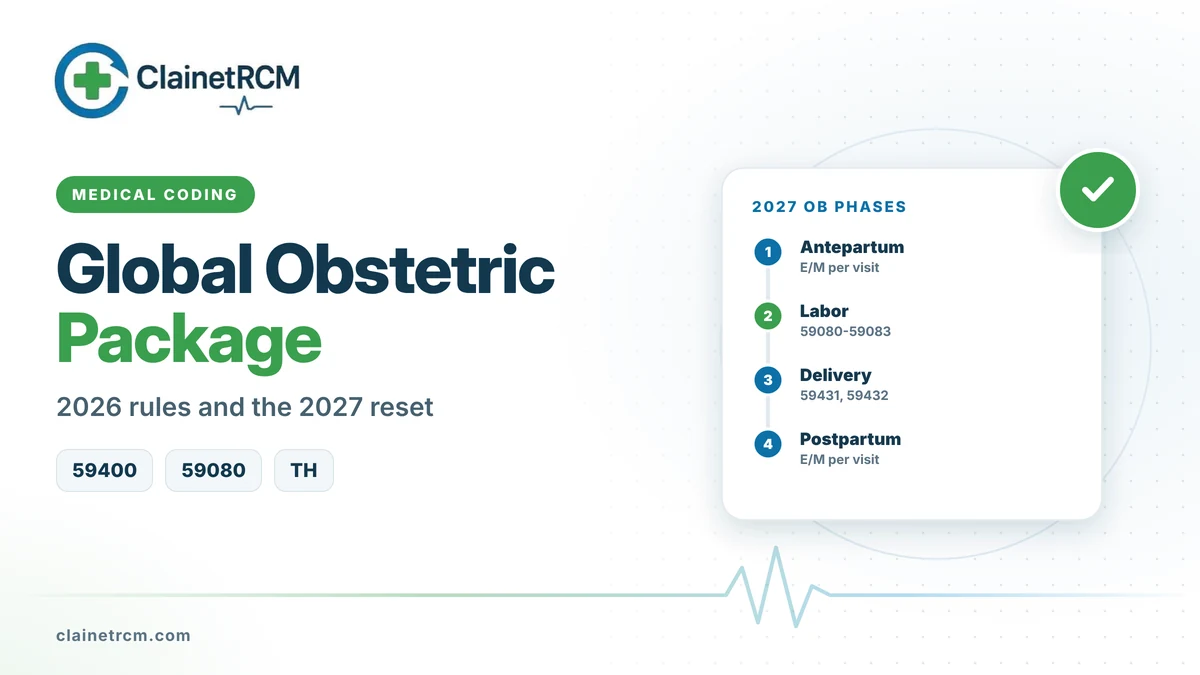
CPT 2027 deletes 17 maternity codes, including 59400, 59409, 59410, 59425, 59426, 59430, 59510, 59514, 59515 and the VBAC series 59610 to 59622, and adds 12 new codes organized around four phases of care.
| Phase | How it is reported starting January 1, 2027 |
|---|---|
| Antepartum care | Each prenatal encounter billed with the E/M code for the setting, such as an office or telehealth visit |
| Labor management | New codes 59080 to 59083 for an initial or subsequent day, straightforward or complex, once per calendar date with a face-to-face encounter |
| Delivery | New vaginal delivery codes 59431 and 59432 (VBAC), plus new codes that separate primary from repeat cesarean delivery |
| Postpartum care | Each postpartum encounter billed with E/M codes; routine postpartum care on the delivery date stays in the delivery code |
The new set also adds distinct codes for third- and fourth-degree laceration or episiotomy repair, hysterectomy after cesarean delivery and uterine tamponade. Many payers and specialty guidance call for HCPCS modifier TH on prenatal and postpartum E/M visits, so confirm each payer’s instructions before January 1, 2027.
Pregnancies That Span 2026 and 2027
Patients who begin prenatal care in 2026 and deliver in 2027 need a split approach. Current guidance from the AAFP and several payers is to count the prenatal visits provided in 2026 and report them under the 2026 rules (E/M codes for one to three visits, 59425 or 59426 for more), then report labor, delivery and postpartum care in 2027 with the new codes. Payer transition policies differ, so check each contract and plan for prenatal visits to be billed as they happen rather than held for a global claim.
Common Errors
- Billing a global code when care was split. If another group delivered or the payer changed, switch to partial-care codes.
- Billing antepartum codes per visit. In 2026, codes 59425 and 59426 are reported once for the whole antepartum period.
- Forgetting separately billable services. Ultrasounds, fetal testing and complication visits are easy to miss.
- Using deleted codes in 2027. Global and partial-care maternity codes cannot be used for dates of service on or after January 1, 2027.
Frequently Asked Questions
Through 2026, it includes routine antepartum care, the delivery and routine postpartum care. Ultrasounds, most labs, procedures such as amniocentesis and care for complications are billed separately.
Yes. CPT 2027 deletes the global maternity codes effective January 1, 2027. Prenatal and postpartum visits will be billed per encounter with E/M codes, and labor management and delivery will have their own codes.
Split the care by payer. Bill antepartum visits to the first payer with the appropriate antepartum code or E/M services, and bill the delivery and remaining care to the new payer.
Codes 59080 to 59083 report labor management for an initial or subsequent day at a straightforward or complex level. They are reported once per calendar date and require a face-to-face encounter.
No. Obstetric ultrasounds are billed separately with the appropriate imaging codes and supporting diagnoses, both now and after 2027.
Final Thoughts
The global obstetric package still applies to 2026 dates of service, but practices should be preparing now for phase-based maternity billing. Learn how we support women’s health practices on our OB/GYN billing page, or review a related procedure in our dilation and curettage CPT code guide.
Get Ready for Phase-Based Maternity Billing
Our OB/GYN billing team closes out 2026 global and partial-care claims correctly and sets up per-visit, labor and delivery coding for 2027 so no part of the pregnancy goes unbilled.
Get OB Billing Help
Written by
ClainetRCM Billing Team
ClainetRCM is a Boston-based revenue cycle management company specializing in medical billing, coding, credentialing and denial management for healthcare providers across all 50 states. Our AAPC and AHIMA certified team works inside your existing EHR, files claims within 24 to 48 hours and reviews every AR bucket on a 14-day cycle.