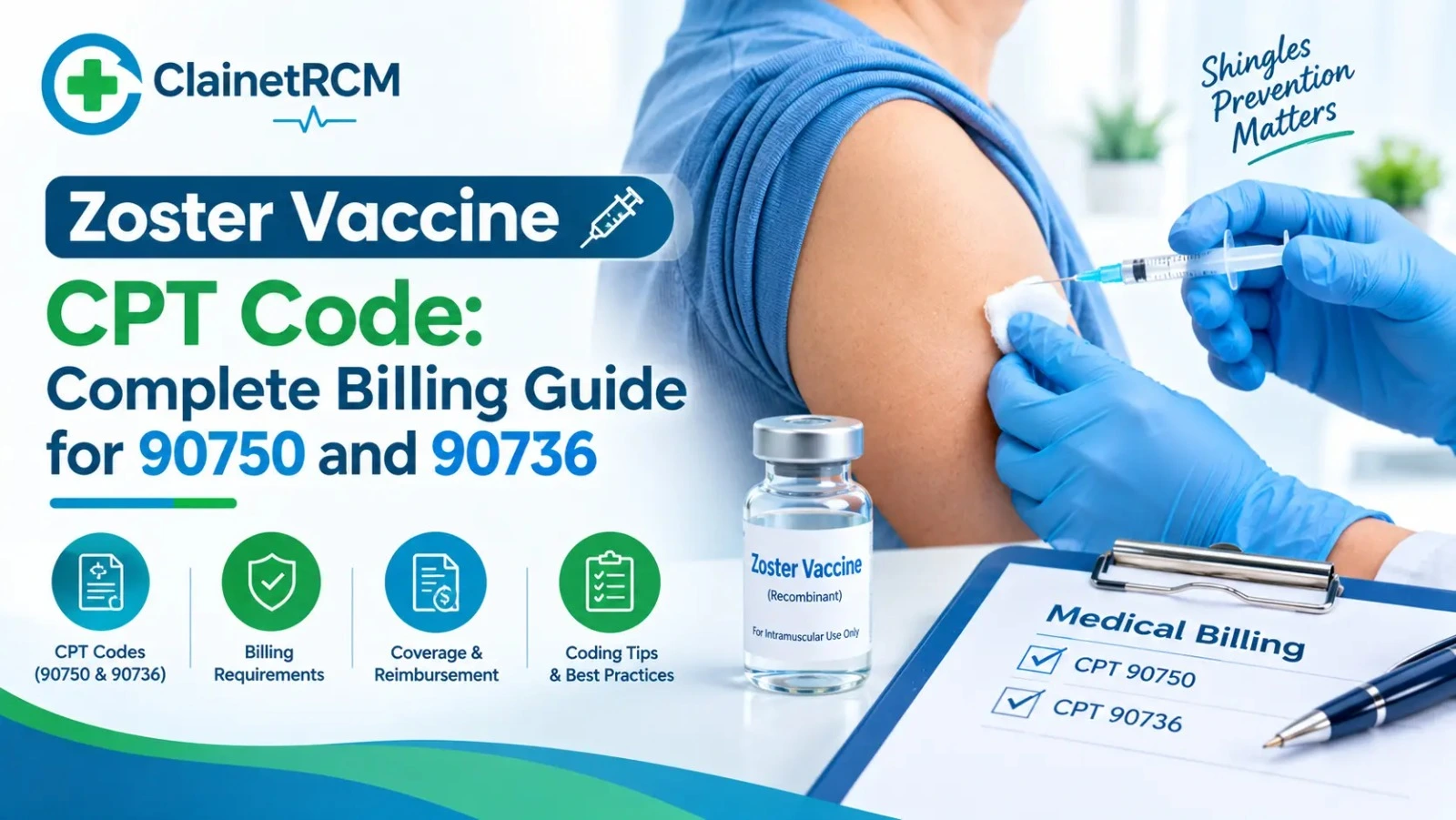
If you are looking for the zoster vaccine CPT code, here is the short answer. For the shingles vaccine used today, Shingrix, the code is CPT 90750. The older live vaccine, Zostavax, used CPT 90736.
That sounds simple, and the code itself is. The trouble starts after you pick it. The vaccine code does not pay for the shot being given, the diagnosis code is not the one most people expect, and Medicare handles this vaccine in a way that surprises many front desks. I have watched practices lose clean money on shingles vaccine claims for years, almost always for the same handful of reasons. This guide walks through each of them so your claim goes out right the first time.
Quick Answer: Zoster Vaccine CPT Codes at a Glance
| Item | Code | What it means |
|---|---|---|
| Vaccine product (Shingrix) | 90750 | Zoster (shingles) vaccine, recombinant, sub-unit, adjuvanted, for intramuscular use |
| Vaccine product (Zostavax) | 90736 | Zoster (shingles) vaccine, live, for subcutaneous injection |
| Administration, first vaccine | 90471 | Immunization administration, one vaccine, single or combination |
| Administration, each additional vaccine | 90472 | Add on code for each extra vaccine given the same day |
| Primary diagnosis | Z23 | Encounter for immunization |
Remember the rule that catches most beginners: the product code and the administration code are two separate lines on the claim. You need both.
What Is the Zoster Vaccine CPT Code?
CPT 90750 sits in the Vaccines, Toxoids subsection of the Medicine section of CPT. Its official descriptor reads: zoster (shingles) vaccine (HZV), recombinant, sub-unit, adjuvanted, for intramuscular use.
In plain language, it identifies the Shingrix product itself. It says nothing about the act of giving the injection. That is why a claim with only 90750 on it is incomplete, and why many payers will either pay the vaccine and nothing for the work, or deny the line outright.
A few practical points about 90750:
- It is reported once per dose, so a patient getting the first and second doses on different dates generates two separate claims, each with one unit.
- Shingrix comes as a lyophilized antigen vial that is mixed with an adjuvant vial before use. A single reconstituted dose is 0.5 mL. You still bill one unit of 90750 per dose, not per vial.
- Some payers want the National Drug Code (NDC) from the vial reported on the vaccine line. Check your payer’s rules, because a missing NDC is a quiet reason for rejections.
CPT 90750 vs 90736: Which Zoster Code Do You Use?
Both codes describe a zoster vaccine, but they describe different products, and only one is in routine use.
| Feature | CPT 90750 | CPT 90736 |
|---|---|---|
| Brand | Shingrix | Zostavax |
| Vaccine type | Recombinant, non live | Live attenuated |
| Route | Intramuscular | Subcutaneous |
| Doses | Two | One |
| Status in the U.S. | Current, recommended | No longer sold in the U.S. since 2020 |
Zostavax stopped being available in the United States in November 2020. The CPT code 90736 remains in the code set, and you might still see it on historical records or on a claim for an old date of service. For any dose given today, 90750 is the code you want.
One more thing worth knowing: Aetna’s clinical policy bulletin lists 90750 as covered when its criteria are met and lists 90736 as not covered for the indications in the policy. If a claim for a current date of service shows 90736, expect trouble.
How to Bill the Administration Code
The administration of the shot is billed with its own code.
- 90471 for the first or only vaccine given at the visit.
- 90472 for each additional vaccine given at the same visit. For example, if a patient receives a shingles shot and a pneumonia vaccine on the same day, one gets 90471 and the other gets 90472.
You may see 90460 and 90461 in coding references too. Those are for patients through age 18 when the provider gives counseling about the vaccine. Shingrix is recommended for adults, so for most zoster vaccine claims they will not apply.
If your office visit and the vaccine happen on the same day, be careful with the E/M code. A separately billable evaluation and management service needs its own significant, separately identifiable work, and the visit documentation must show it. Quick counseling about the vaccine is part of giving the vaccine. If the E/M is truly separate, modifier 25 goes on the E/M line. Slapping 25 on every visit that includes a shot is an audit invitation.
Strong coding support matters here, and a good medical coding team will catch these pairings before the claim leaves your system.
ICD-10 Codes for Zoster Vaccine Claims
Here is where people trip. The diagnosis for a zoster vaccination claim is Z23, Encounter for immunization. It should be listed first.
Many billers see “zoster” and reach for the B02 category, which covers herpes zoster disease, such as B02.9 for zoster without complications. Those codes describe a patient who has shingles. They do not describe a patient who is getting vaccinated against it. Using B02 on a vaccine claim tells the payer the patient has the disease, which is simply wrong.
For adults aged 19 to 49 who are immunocompromised, the payer will want to see why a patient under 50 is receiving the vaccine. The documentation should support the immune condition, and the claim may need a secondary diagnosis that reflects it. An example is D84.821, immunodeficiency due to drugs, when that is what the record supports. Your coder should pick the code that matches the provider’s note, never one chosen just to get past an edit.
Who Qualifies: Age and Dose Rules That Affect Payment
Payers build their edits around the CDC’s recommendations, so a biller should know them cold.
- Adults 50 and older: two doses of Shingrix, given 2 to 6 months apart.
- Adults 19 and older who are or will be immunodeficient or immunosuppressed: two doses, and the second dose can be given 1 to 2 months after the first because these patients need protection sooner.
- Minimum spacing: a minimum interval of 4 weeks between doses applies in the schedule guidance. A second dose billed earlier than that is the kind of claim that gets denied.
- Prior shingles or prior Zostavax: the CDC still recommends Shingrix for people who have had shingles or who got Zostavax before.
- No chickenpox history screening: for immunocompetent adults 50 and older, there is no need to screen for a history of chickenpox or order lab tests before vaccinating.
- Pregnancy: there is currently no CDC recommendation for Shingrix use in pregnancy, so providers should consider delaying vaccination until after pregnancy.
Why does this matter for billing? Because age edits and frequency edits are built on these rules. A 45 year old with no immune condition documented will often be denied. A second dose submitted three weeks after the first will often be denied. Both problems are fixed at the front desk, not in the denial queue.
Medicare and the Zoster Vaccine: The Part D Rule
This is the most important section of the whole article, because it is where the most money goes missing.
Medicare covers Shingrix under Part D, not Part B. Most of what a physician office bills to Medicare runs through Part B. Shingrix does not. A 90750 and 90471 claim sent to a Part B contractor for a Shingrix dose will deny.
Here is what the Part D setup looks like:
- Since January 1, 2023, the Inflation Reduction Act removed cost sharing for ACIP recommended adult vaccines covered under Part D. A beneficiary with Part D coverage pays $0 for each dose of Shingrix.
- That applies to standalone Part D plans and to Medicare Advantage plans that include drug coverage.
- The vaccine and its administration are paid through the Part D transaction, not through a medical claim.
- Because the Physician Fee Schedule does not set a Medicare rate for Shingrix, you will not find a standard Medicare allowable for 90750. Payment depends on the Part D plan’s negotiated rate.
Most Medicare patients end up getting this vaccine at a pharmacy, where the Part D claim runs smoothly. GSK reports that more than 95 percent of Medicare Part D enrollees receive Shingrix at a pharmacy. A physician office can still give the vaccine, but it needs a way to bill the Part D plan, such as an electronic pharmacy billing arrangement. If the office cannot do that, the patient may be asked to pay upfront and file a paper claim with their plan for reimbursement. That is exactly the situation patients complain about, and it is a good reason to confirm Part D billing capability before you stock the vaccine.
Practical steps for your front desk:
- Ask for the patient’s Part D plan information at intake, not only the Part B card.
- Confirm whether your office can bill that plan before the injection is given.
- If you cannot, tell the patient honestly and point them to a pharmacy so they are not surprised by a bill.
If your practice sees a lot of older adults, this issue will come up daily. Practices handling geriatrics billing usually build a Part D check into every vaccine visit for this reason.
Commercial Insurance and Medicaid
For commercial plans, the common pattern is a single claim with 90750 and 90471, diagnosis Z23, and the NDC if the payer asks for it. Under the Affordable Care Act, Marketplace plans and most private plans must cover ACIP recommended vaccines, including Shingrix, with no deductible, copay or coinsurance when it is given in network. Always verify the benefit, because grandfathered plans and some employer plans behave differently.
Medicaid varies by state. As one example, North Carolina Medicaid covers Shingrix when billed with 90750 and requires Z23 as the diagnosis. In that state, pharmacists administering the vaccine also have to add a CG modifier to both the vaccine and administration codes. Do not copy another state’s rules. Check your own state’s Medicaid billing guidance, because modifier and provider type requirements change from state to state.
A Simple Sample Claim
Here is what a clean commercial claim for a first Shingrix dose looks like in structure:
- Patient: 62 years old, no immune condition
- Line 1: CPT 90750, 1 unit, linked to Z23, with NDC if required
- Line 2: CPT 90471, 1 unit, linked to Z23
- Diagnosis: Z23 listed first
- Dose two: a separate claim, usually 2 to 6 months later, built the same way
If an unrelated problem was also treated and truly needed its own visit, that E/M goes on its own line with modifier 25 and its own diagnosis pointer.
Common Zoster Vaccine Denials and How to Fix Them
| Denial cause | Why it happens | Fix |
|---|---|---|
| Sent to Medicare Part B | Shingrix is a Part D benefit | Bill the Part D plan, or refer the patient to a pharmacy |
| Missing administration code | Only 90750 was billed | Add 90471 or 90472 |
| Wrong diagnosis | B02 used instead of Z23 | Make Z23 the primary diagnosis |
| Age edit | Patient is under 50 with no immune condition on the claim | Document and code the qualifying condition, or confirm eligibility first |
| Dose too soon | Second dose billed inside the minimum interval | Check the date of dose one before scheduling |
| Wrong product code | 90736 billed for a current Shingrix dose | Correct to 90750 |
| Missing NDC | Payer requires it on the vaccine line | Add the NDC from the vial |
| E/M bundled | No separate, documented E/M work | Bill the E/M only when the note supports it |
| Duplicate or frequency denial | Same dose submitted twice | Check prior claims and immunization records |
Most of these are preventable. Good claim denials prevention habits, such as checking eligibility and edits before the visit, remove the majority of them. And when you build the claim itself, the checklist in a guide on clean claims in medical billing applies directly to vaccine lines.
Quality Reporting Codes You May See: M1174, M1175 and M1176
Along with the CPT code, you may run into a few HCPCS quality codes related to zoster vaccination:
- M1174: patient received at least two doses of the recombinant herpes zoster vaccine, at least 28 days apart, within the measurement period
- M1175: documentation of a medical reason for not giving the zoster vaccine, for example prior anaphylaxis to the vaccine
- M1176: patient did not receive two doses of the recombinant vaccine within the measurement period
These are quality reporting codes. They tell a payer or program whether the quality measure was met. They are not a substitute for 90750, and they do not replace the billing codes that get the vaccine and its administration paid.
Documentation Checklist Before You Submit
Good documentation protects you in an audit and prevents denials. For every dose, the record should show:
- Patient name, date of birth and date of service
- Vaccine name and dose number (first or second)
- Lot number, expiration date and manufacturer
- Injection site and route
- Name and credentials of the person who gave the vaccine
- Evidence that the patient received the vaccine information statement
- Reason for vaccination when the patient is under 50 (the immune condition)
- Insurance details, including Part D information for Medicare patients
Frequently Asked Questions
The CPT code for the current shingles vaccine, Shingrix, is 90750. The older live vaccine, Zostavax, was reported with 90736.
Yes. 90750 reports the vaccine product, and 90471 reports the administration of the first or only vaccine at the visit. Use 90472 for each additional vaccine given the same day.
Use Z23, Encounter for immunization, as the primary diagnosis. Do not use the B02 codes unless the patient actually has shingles.
No. Shingrix is covered under Medicare Part D. A Part B claim for it will typically deny.
Patients with Part D coverage pay $0 per dose since the Inflation Reduction Act removed cost sharing for recommended adult vaccines in 2023. Patients without Part D coverage may owe the full price.
The code still exists in CPT, but Zostavax is no longer sold in the United States. Use 90736 only for historical dates of service when the live vaccine was actually given.
Two doses. For adults 50 and older, the second dose is given 2 to 6 months after the first. For immunocompromised adults 19 and older, it can be given 1 to 2 months after the first.
Yes. Pharmacies commonly give Shingrix and bill it, with rules that differ by payer and state. Some Medicaid programs, for example, require a CG modifier for pharmacist administration.
Final Thoughts
The zoster vaccine CPT code is easy to remember: 90750 for Shingrix. What decides whether you get paid is everything around it. Bill the administration code on its own line, lead with Z23, check the age and dose interval, and never send a Medicare Shingrix dose to Part B. Do those four things and most of your zoster vaccine denials disappear.
Billing rules for vaccines also shift with payer policy and annual code updates, so confirm the current requirements with each payer before you build your workflow.
Tired of Losing Revenue to Vaccine Billing Errors?
Clainet RCM helps practices code accurately, bill the right payer and recover denied claims, so every dose you give gets paid.
Talk to Our Billing Experts Today
Written by
ClainetRCM Billing Team
ClainetRCM is a Boston-based revenue cycle management company specializing in medical billing, coding, credentialing and denial management for healthcare providers across all 50 states. Our AAPC and AHIMA certified team works inside your existing EHR, files claims within 24 to 48 hours and reviews every AR bucket on a 14-day cycle.