Dental CDT codes are the procedure codes dental practices use on every claim. The Code on Dental Procedures and Nomenclature (CDT) is maintained by the American Dental Association, is required for electronic dental claims under HIPAA and is updated every January 1. Most dental revenue comes from a few dozen codes, and most denials come from frequency limits, missing narratives and missing X-rays rather than from the codes themselves.
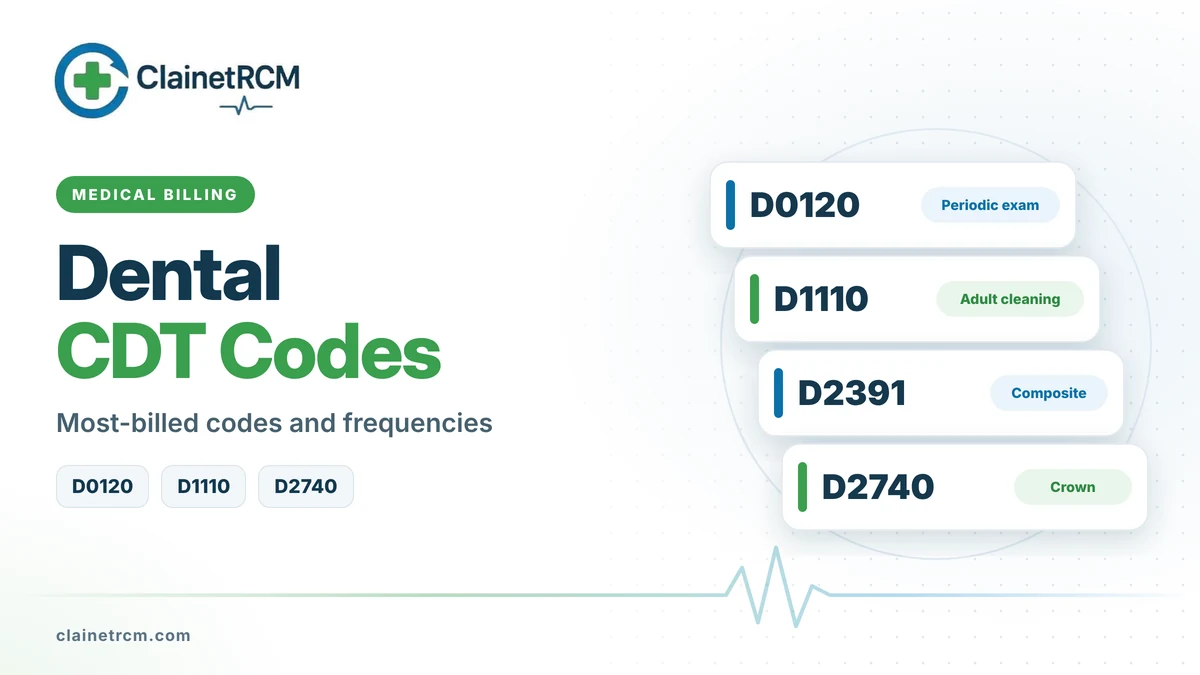
Quick answer: The codes most practices bill are periodic and comprehensive evaluations (D0120, D0150), bitewings and panoramic images (D0274, D0330), cleanings (D1110 for adults, D1120 for children, D4910 for periodontal maintenance), fillings (such as D2391 for a one-surface posterior composite), crowns and buildups (D2740, D2950), scaling and root planing (D4341) and extractions (D7140). Check each patient’s frequency limits before treatment, attach X-rays and narratives for major services and update your software for each new CDT version, including CDT 2027 on January 1, 2027.
Most-Billed Dental CDT Codes
| Category | Codes | Description |
|---|---|---|
| Evaluations | D0120, D0140, D0150, D0180 | Periodic, limited problem-focused, comprehensive and comprehensive periodontal evaluations |
| Imaging | D0210, D0220, D0230, D0272, D0274, D0330 | Full-mouth series, periapicals, two and four bitewings, panoramic |
| Preventive | D1110, D1120, D1206, D1208, D1351 | Adult and child prophylaxis, fluoride varnish, topical fluoride, sealant |
| Restorative | D2140 to D2161, D2330 to D2335, D2391 to D2394 | Amalgam, anterior composite and posterior composite fillings by surfaces |
| Crowns | D2740, D2750, D2950 | Porcelain/ceramic crown, porcelain fused to high noble metal, core buildup |
| Endodontics | D3310, D3320, D3330 | Root canal therapy: anterior, premolar, molar |
| Periodontics | D4341, D4342, D4355, D4910 | Scaling and root planing (four or more teeth, one to three teeth), full-mouth debridement, periodontal maintenance |
| Oral surgery | D7140, D7210 | Extraction of an erupted tooth, surgical extraction |
Common Frequency Limitations
Frequency rules are set by each dental plan, not by CDT, so verify benefits for every patient. Typical limits include:
| Service | Common limit |
|---|---|
| Periodic evaluation (D0120) | Twice per year or once every six months |
| Prophylaxis (D1110, D1120) | Twice per year |
| Periodontal maintenance (D4910) | Two to four times per year, sometimes shared with prophylaxis |
| Bitewings (D0272, D0274) | Once per year |
| Full-mouth series or panoramic image | Once every three to five years |
| Fluoride | Twice per year up to a set age |
| Sealants | Once per tooth on permanent molars, with age limits |
| Crowns | Once per tooth every five to seven years |
| Scaling and root planing | Once per quadrant every 24 to 36 months |
A claim submitted one day early can deny, so track last service dates in your practice management system and check them at scheduling.
Narratives and Attachments That Get Claims Paid
- Crowns and buildups: state why the tooth needs coverage, such as a fracture, recurrent decay or a large failing restoration, and attach a pre-operative X-ray and, ideally, an intraoral photo.
- Scaling and root planing: attach a periodontal chart showing pocket depths of 4 mm or more and X-rays showing bone loss.
- Replacements: give the date of the prior crown, bridge or denture and why it failed.
- Full-mouth debridement: explain why heavy deposits prevent a comprehensive evaluation.
- Extractions: describe the reason, such as non-restorable decay or periodontal disease.
CDT 2026 and CDT 2027 Updates
CDT 2026 took effect January 1, 2026, with 31 new codes, 6 deletions and multiple revisions, including codes for point-of-care saliva testing, cracked tooth testing and cleaning and inspection of an occlusal guard (D9936), along with an overhaul of the sedation and anesthesia codes.
CDT 2027 takes effect January 1, 2027, with 67 changes: 28 new codes, 33 revisions and 6 editorial updates. New codes include healing cap placement, removal of screw-retained implant restorations, repairing or removing fixed splints, orofacial pain injections such as occipital nerve blocks and trigger-point injections, and codes that separate cosmetic from therapeutic chemodenervation. Update your fee schedule, software and templates before January, and never bill a new code for a date of service before its effective date.
Claim Submission Tips
- Tooth, surface and quadrant. Report tooth numbers and surfaces for restorations and quadrants for periodontal procedures exactly as the code requires.
- Dates of prior work. For replacements, include the date the original crown, bridge or denture was placed.
- Clear images. Send recent, readable X-rays that show the full tooth and surrounding bone.
- Coordination of benefits. Confirm primary and secondary dental coverage before submitting, and attach the primary payer’s explanation of benefits to secondary claims.
- Predeterminations. For crowns, bridges and implants, request a predetermination when the plan offers one, so the patient knows the expected coverage.
When Dental Services Go to Medical Insurance
Some procedures performed in a dental office are billed to medical insurance with CPT and ICD-10 codes, such as treatment after an accident, certain oral surgery, biopsies and oral appliances for obstructive sleep apnea. Cross-coding requires medical documentation, diagnosis codes and often prior authorization.
Frequently Asked Questions
D0120 is a periodic evaluation for an established patient. D0150 is a comprehensive evaluation, usually for a new patient or an established patient with a significant change in health or after a long absence.
Use D4910 for periodontal maintenance after active periodontal therapy, such as scaling and root planing. D1110 is a routine prophylaxis for patients without a history of periodontal treatment.
The most common reasons are a missing pre-operative X-ray, a missing narrative explaining the need, a replacement within the plan’s frequency limit or a missing date of prior placement.
Every year. Each new CDT version takes effect January 1, so update your software and fee schedule before the new year.
Yes, for certain services such as trauma care, some oral surgery, biopsies and sleep apnea appliances, using CPT and ICD-10 codes with medical documentation.
Final Thoughts
Dental CDT codes are simple to look up but harder to get paid, because frequency limits, narratives and attachments decide most claims. Learn how we support dental practices on our dental billing page, or explore our specialty medical billing guide.
Get Dental Claims Paid on the First Pass
Our dental billing team verifies frequencies, writes narratives, attaches the right X-rays and keeps your fee schedule current with each CDT update.
Get Dental Billing Help
Written by
ClainetRCM Billing Team
ClainetRCM is a Boston-based revenue cycle management company specializing in medical billing, coding, credentialing and denial management for healthcare providers across all 50 states. Our AAPC and AHIMA certified team works inside your existing EHR, files claims within 24 to 48 hours and reviews every AR bucket on a 14-day cycle.