
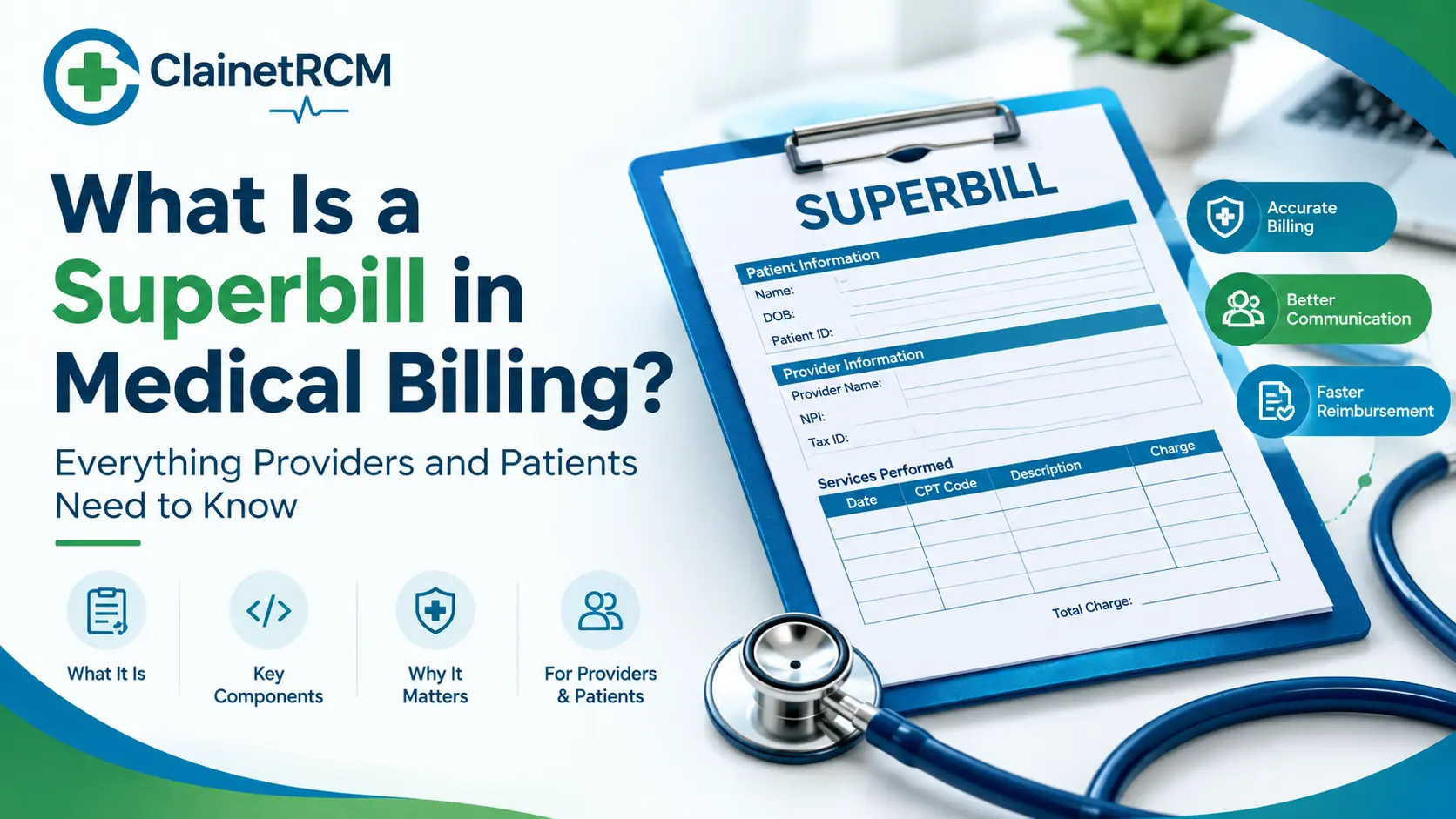
A superbill is an itemized document that lists the services a patient received during a visit, along with the codes and provider details an insurance company needs to process a reimbursement. It is not a bill in the traditional sense. It is closer to a detailed receipt that bridges the gap between the exam room and the insurance company's claims department.
If you searched for this term, you are probably in one of two situations. Either you are a patient who was just handed a superbill and told to "submit it to your insurance," or you run a practice and need to understand how to build one that actually gets paid instead of denied. This guide covers both, with the kind of practical detail that comes from actually working claims, not just reading about them.
The Simple Definition of a Superbill
A superbill is a detailed record of a patient encounter that includes the provider's information, the patient's information, the date of service, the diagnosis codes, the procedure codes, and the amount charged. Patients use it to request reimbursement from their insurance company when the provider does not bill the insurer directly.
Providers who are not in-network with a payer, or who choose not to bill insurance at all, hand this document to the patient instead of submitting a claim on their behalf. The patient pays for the visit out of pocket, then sends the superbill to their insurance company and waits to see whether any of that money comes back.
You may also hear it called an encounter form, a charge slip, or a fee ticket. All of these names describe the same underlying document.
Superbill vs. Medical Bill vs. CMS-1500 Claim Form
People mix these three up constantly, and the confusion causes real problems when patients try to figure out what to do with the paperwork in front of them.
| Document | Who receives it | Who pays first | Purpose |
|---|---|---|---|
| Superbill | Patient | Patient | Lets the patient request reimbursement from their own insurer |
| Medical bill / invoice | Patient | Patient | Simple statement of what the patient owes the practice |
| CMS-1500 claim form | Insurance payer | Insurer (pays the provider directly) | Standard form used by in-network providers to bill insurance directly |
The core difference comes down to who the payment flows to first. When a provider is in-network, they submit a CMS-1500 (or its electronic equivalent) straight to the payer, and the payer reimburses the provider. When a provider is out-of-network or private-pay, the superbill hands that job to the patient, who becomes responsible for filing the claim themselves.
What Information Belongs on a Superbill
There is no single mandated format, but payers expect the same core fields regardless of specialty. A superbill that is missing any of the following is far more likely to come back denied or underpaid:
- Provider's full name, credentials, practice address, phone number, and National Provider Identifier (NPI)
- Patient's full name, date of birth, and insurance ID number
- Date of service and place of service code
- ICD-10 diagnosis codes describing why the patient was seen
- CPT (or HCPCS) procedure codes describing what was actually done
- The fee charged for each service, plus the total
- Amount the patient already paid at the time of service
- Provider's signature or credentialed signature line
Practices that build their superbill template around this checklist, rather than a generic invoice format, see noticeably fewer rejected claims. A template is only as good as the fields it forces someone to fill in before the document leaves the office.
Who Actually Uses Superbills
Superbills show up most often in practices that either cannot or choose not to bill insurance directly. That includes:
- Mental health providers, including therapists, psychologists, and psychiatrists who are not credentialed with a specific payer
- Physical therapists, chiropractors, and occupational therapists working with out-of-network patients
- Direct primary care and concierge medicine practices that operate on a membership model
- Dermatology, dental, and specialty practices that see a mix of insured and self-pay patients
- Any provider who has intentionally opted out of a payer's network but still wants to help patients recover part of the cost
If your practice serves a specialty with a high volume of self-pay or out-of-network visits, superbills are not optional paperwork. They are part of how your patients afford to keep coming back. Practices in behavioral health, counseling and therapy, and chiropractic care run into this dynamic more than almost any other specialty, since these are the fields where out-of-network care is most common.
How the Superbill Process Actually Works, Step by Step
For patients, the process is more predictable than it feels the first time you go through it:
- You see an out-of-network or private-pay provider and pay the full fee at the time of service.
- The provider gives you a superbill listing the visit's codes, diagnosis, and charges.
- You log into your insurance company's website or app and locate the out-of-network claim submission section.
- You upload the superbill (most insurers accept a PDF or photo) and confirm your policy details.
- Your insurer applies your out-of-network deductible and coinsurance, then decides how much of the "allowed amount" it will reimburse.
That last step is where a lot of patients feel misled, though nothing dishonest actually happened. Say your therapist charges $175 per session and your plan's allowed amount for that CPT code is $120. Until you have met your out-of-network deductible, you get nothing back. After that, you might get 60% of $120, which is $72, not 60% of the $175 you actually paid. The superbill did its job correctly. The plan design is simply built around a lower "allowed amount" than what providers actually charge.
The CPT and ICD-10 Codes That Drive Every Superbill
Two coding systems sit underneath every superbill, and understanding how they interact matters more than memorizing individual codes.
CPT codes (Current Procedural Terminology) describe what was done during the visit. A few examples that appear constantly on real superbills:
- 99214, an established patient office visit of moderate complexity
- 90834, a 45-minute individual psychotherapy session
- 90837, a 60-minute individual psychotherapy session
- 36415, a routine venous blood draw
ICD-10 codes describe why the patient needed the service in the first place. Examples include F41.1 for generalized anxiety disorder, I10 for essential hypertension, and M54.5 for low back pain.
A superbill is only clean when the CPT code and the ICD-10 code make clinical sense together. Billing a 60-minute psychotherapy session against a diagnosis code for a sprained ankle is an automatic denial, and payer systems catch that mismatch instantly. If your team regularly bills specific procedure codes, it helps to keep a reference on hand. Our breakdowns of CPT code 52000, the EGD CPT code, and HCPCS code J3490 walk through exactly how those specific codes should be documented and paired to avoid rejections.
The Mistakes That Turn a Superbill Into a Denial
Most superbill-related denials trace back to a small handful of preventable errors:
- Outdated codes. CPT codes are revised every year by the AMA, and ICD-10 codes are updated annually. A code that was valid last year can be deleted this year, and a claim built on a deleted code gets an automatic rejection.
- Mismatched diagnosis and procedure codes. Payer software flags illogical pairings before a human ever looks at the claim.
- Missing modifiers. A two-digit modifier that indicates laterality, telehealth delivery, or a bilateral procedure can be the difference between a paid claim and a denied one.
- Provider credentials that do not match payer records. If the NPI on the superbill does not match what the insurer has on file, the claim fails immediately, regardless of how accurate the codes are.
- Small data errors. A transposed digit in an insurance ID or a mismatched date of birth is a surprisingly common cause of rejection.
None of these are complicated problems on their own. They are just the kind of small, repeatable mistakes that pile up when a practice does not have a dedicated review step before the superbill or claim goes out. Our guide on preventing claim denials breaks down a practical, repeatable review process practices can put in place before submission, not after a rejection letter shows up.
Why Credentialing Status Changes Everything About Your Superbills
Here is a connection most guides skip entirely. Whether your practice even needs to issue superbills in the first place often comes down to your credentialing status with each payer.
A provider who is fully credentialed and in-network with a payer bills that insurer directly using a standard claim form. A provider who has not completed credentialing with a specific plan, or whose credentialing has lapsed, has no choice but to treat that payer's patients as out-of-network, which means issuing superbills whether they intended to or not.
This is where a lot of practices lose revenue without realizing it. If your credentialing status with a major payer has lapsed or was never completed, you are effectively forcing every patient covered by that plan into the superbill and reimbursement process, which slows down payment and creates friction patients notice. Our overview of how credentialing gaps affect revenue covers exactly how this plays out and what it costs a typical practice over a year. If you are unsure where your practice stands with a specific payer, our insurance credentialing team can review your current status across every plan you work with.
How to Build a Superbill Template That Actually Gets Paid
A strong superbill template is not a form you fill out after the visit. It is a denial-prevention tool that forces every required field to be captured before the patient walks out the door. At minimum, build your template around:
- Provider name, credentials, NPI, and practice contact information (pre-filled, never left blank)
- Patient name, date of birth, and insurance ID
- Date and place of service
- A structured field for ICD-10 codes with a short description next to each one
- A structured field for CPT codes with modifier lines built in
- Fee per line item and a running total
- Amount collected from the patient at time of service
- A signature line tied to the treating provider
If your practice management or EHR software can validate code pairings automatically before the document is finalized, use that feature. It catches the mismatched code problem described above before it ever becomes a denied claim.
Should Your Practice Handle Superbills In-House or Outsource Them?
Small practices, solo providers, and specialty clinics often start out generating superbills manually, usually through an EHR template or even a spreadsheet. That works fine at low volume. It starts to break down once a practice is issuing dozens of superbills a week across multiple providers and specialties, because every superbill is a small opportunity for a coding mismatch, a missing modifier, or an outdated credential to slip through.
This is the exact gap that outsourced revenue cycle management exists to close. A dedicated medical billing and medical coding team reviews every code pairing before it leaves the building, keeps provider credentials current across every payer through ongoing credentialing, and follows up on anything that does get denied through active denial management instead of letting it sit in a queue for weeks.
Practices that make this shift typically notice two things right away: fewer denied claims tied to superbill errors, and faster patient reimbursement, which translates directly into better patient collections and fewer billing complaints at the front desk.
Superbill FAQs
Is a superbill the same thing as a bill?
No. A superbill is a detailed receipt used to request insurance reimbursement. A regular medical bill simply states what a patient owes the practice, with no coding detail required for insurance submission.
Who typically issues a superbill?
Out-of-network providers, private-pay practices, direct primary care offices, and specialists such as therapists, chiropractors, and psychiatrists who are not credentialed with a specific insurance plan.
Does a superbill guarantee reimbursement?
No. Reimbursement depends on the patient's specific plan, whether they have out-of-network benefits, whether they have met their deductible, and the insurer's allowed amount for that service.
What codes are required on a superbill?
At minimum, a CPT or HCPCS procedure code describing the service and an ICD-10 diagnosis code describing the reason for the visit. Both must logically match for the claim to be accepted.
Can a therapist bill insurance directly instead of using a superbill?
Yes, but only if the therapist is credentialed and in-network with that specific payer. Otherwise, the visit is treated as out-of-network and a superbill is the standard path to reimbursement.
How long does superbill reimbursement usually take?
Once submitted, most insurers process out-of-network claims within 2 to 6 weeks, though this varies significantly by payer and by whether the superbill contains any coding errors.
What is the most common reason a superbill gets rejected?
Mismatched or outdated CPT and ICD-10 code pairings, followed closely by provider credential mismatches and missing modifiers.
Final Thoughts
A superbill looks like a simple form, but it sits at the exact point where clinical care turns into a financial transaction. Get the details right, and it becomes a fast, predictable path to reimbursement for patients and clean revenue for providers. Get it wrong, and it becomes weeks of delay, appeals, and frustrated front desk calls.
Whether you are building your first superbill template or trying to figure out why half of yours keep coming back denied, the fix usually comes down to the same few things: current codes, matching diagnosis and procedure pairs, accurate provider credentials, and a review step before anything goes out the door.
Tired of Chasing Denied Claims and Reimbursement Delays?
Clainet RCM helps practices across all 50 states build clean superbills, stay credentialed with every payer, and get paid faster with fewer denials. Our billing and coding specialists review every claim before it goes out, not after it comes back.
Talk to an RCM Specialist
ClainetRCM Billing Team
ClainetRCM is a Boston-based revenue cycle management company specializing in medical billing, coding, and denial management for healthcare providers across all 50 states. Our AAPC and AHIMA certified coders track every ICD-10-CM update so claims go out coded to the current fiscal year's release.