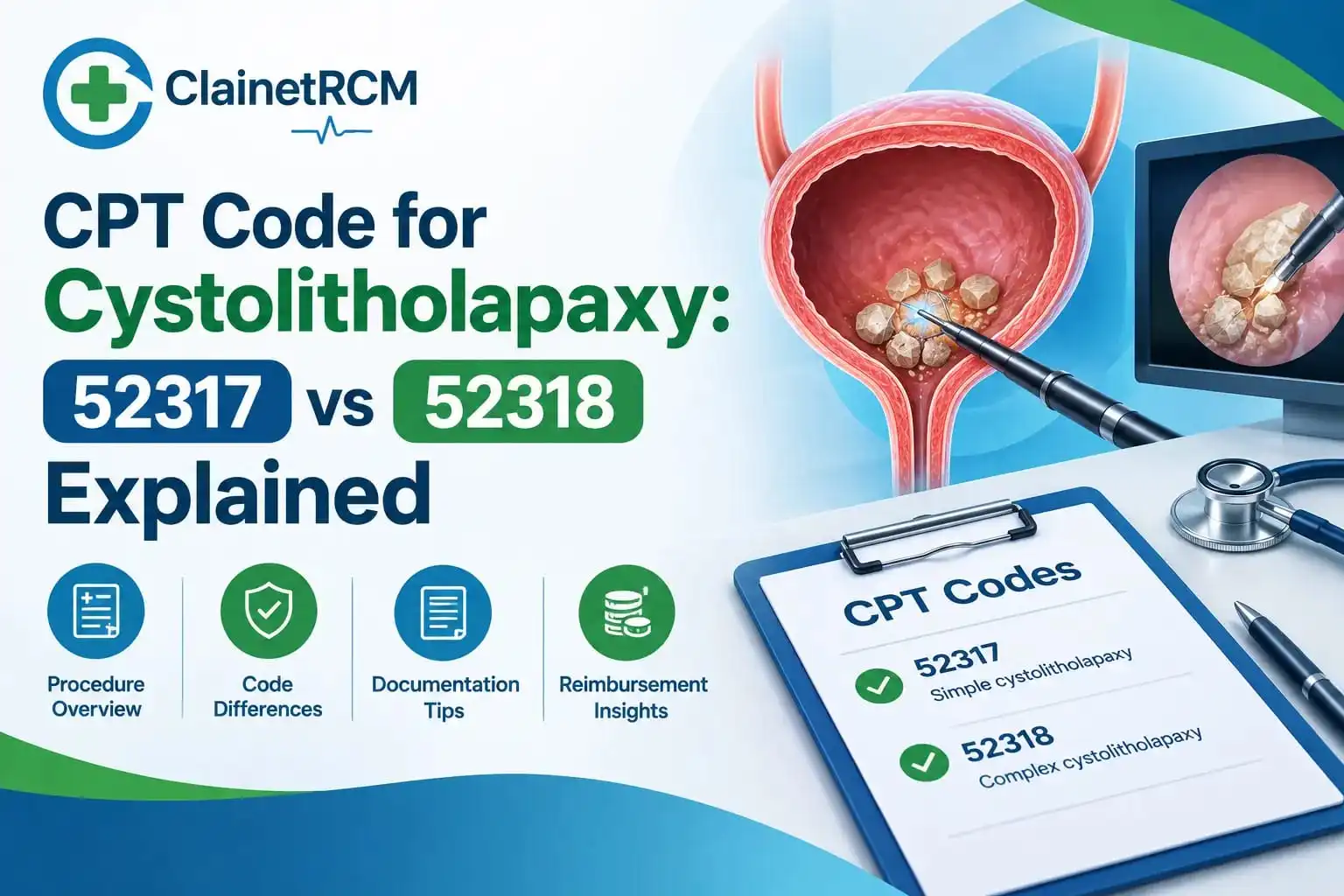
Quick answer: Cystolitholapaxy is reported with CPT 52317 when the bladder stone is simple or smaller than 2.5 cm, and CPT 52318 when it is complicated or larger than 2.5 cm. Both codes include the cystourethroscopy, carry a 000 day global period, and require the operative note to show that the stone was crushed or fragmented and the fragments removed.
If you have ever sat with an operative note that says “bladder stone removed” and wondered which code the surgeon really earned, you are not alone. This is one of those urology procedures where the code looks simple on paper, yet the claim still bounces for reasons that have nothing to do with the code number itself. Size, method, stone count and approach all change the answer.
This guide walks through the codes, the rules around them, and the documentation habits that keep these claims paid on the first submission.
What Cystolitholapaxy Actually Means
Cystolitholapaxy is the endoscopic crushing of a bladder stone and the washing out of the fragments. The urologist passes a cystoscope through the urethra, breaks the stone with a laser, electrohydraulic probe, ultrasound or a mechanical lithotrite, and then evacuates the pieces so nothing is left behind to start the problem again.
CPT does not use the word cystolitholapaxy. The code descriptor says “litholapaxy: crushing or fragmentation of calculus by any means in bladder and removal of fragments.” So when someone searches for the cpt code for cystolitholapaxy, they are really looking for the litholapaxy codes in the transurethral surgery section of CPT.
Patients usually reach this procedure because of bladder outlet obstruction, an enlarged prostate, a neurogenic bladder, long term catheter use or recurrent infections. Bladder stones are rarely a stand alone story, and that matters later when we choose diagnosis codes.
The Two CPT Codes You Need
| CPT Code | Descriptor (short) | When to use it |
|---|---|---|
| 52317 | Litholapaxy, simple or small (less than 2.5 cm) | Stone under 2.5 cm, straightforward fragmentation |
| 52318 | Litholapaxy, complicated or large (over 2.5 cm) | Stone over 2.5 cm, or documented complexity |
Both codes sit in the transurethral surgery range for the urethra and bladder, and both have been in CPT since 1990. Both have a 000 day global period, so the procedure itself is paid, and only related care on a later date falls under special rules.
The words “simple” and “small” are doing real work. Size is the first test, but the operative note should also tell the story of why the case was simple or complicated.
The 2.5 cm Problem Nobody Warns You About
CPT says less than 2.5 cm for 52317 and over 2.5 cm for 52318. So what happens when the surgeon measures exactly 2.5 cm? The code set does not give an answer, and coding forums have debated this for years.
My advice is practical. Do not guess. Send a short query to the surgeon asking whether the case was simple or complicated based on the procedure itself. A stone that sits at 2.5 cm but was hard, adherent or required extended laser time supports 52318. A soft stone that broke up quickly supports 52317. Whatever the surgeon decides, the note should say why.
Also check how the size was recorded. A stone measured on imaging before surgery and a stone measured in the operating room are not always the same number. Intraoperative findings should drive code selection, so make sure the operative note carries its own measurement and does not just echo the CT report.
Cystolitholapaxy vs Simple Stone Removal (52310 and 52315)
This is the single most common mistake I see. If the stone is small enough to be grasped and pulled out without being broken up, litholapaxy did not happen. The right family is cystourethroscopy with removal of a foreign body, calculus or ureteral stent, which is 52310 for simple and 52315 for complicated.
The test is easy to state. Was the stone crushed or fragmented? If yes, look at 52317 or 52318. If the stone was simply grabbed and removed whole, look at 52310. Coders who default to 52317 because the note says “bladder stone” are creating audit exposure, and payers know to look for it.
For a refresher on how the base cystoscopy codes fit together, our guide to the CPT code for cystoscopy breaks down the range.
What Is Bundled Into 52317 and 52318
The diagnostic cystourethroscopy is built into the litholapaxy codes. You do not bill CPT 52000 on top of 52317 or 52318 for the same session, because 52000 is a separate procedure code and CPT treats it as part of the more complex service.
The same logic applies to the routine steps of the case: inspecting the bladder, irrigating, evacuating fragments and placing a simple catheter at the end. Other procedures done in the same session, such as a prostate resection or bladder tumor treatment, need to be checked against NCCI edits before you add them. When a second procedure is separately reportable, modifier 51 may apply depending on the payer.
Coding Multiple Stones
Here is a question that comes up more than you would think: a patient has many small stones, say 40 of them, and each one is under 2.5 cm. Do you add them up? Do you bill 52317 once? Do you add modifier 22?
CPT has no unit language for multiple stones in these codes, unlike the bladder tumor codes, which are written by tumor size. Guidance published in Urology Times recommended 52318 for a case with many calculi because of the complexity of clearing them in one session, and advised against adding modifier 22 to 52317 since 52318 already describes a complicated litholapaxy regardless of stone size.
That is a recommendation, not a rule written into CPT, so your payer policy and your compliance team have the final word. What I would insist on is documentation: stone count, approximate sizes, total operative time and why the case was harder than a standard 52317.
When the Approach Is Not Transurethral
Litholapaxy codes describe a transurethral cystoscopic approach. What about stones removed through a suprapubic or percutaneous tract? AHA Coding Clinic for HCPCS, 2026 Issue 2, addressed a case of endoscopic bladder stone removal through a percutaneous cystotomy and asked whether a separate code or an unlisted code is appropriate.
If you meet this situation, do not force the case into 52317 or 52318 just because the stone was crushed. Read the Coding Clinic response, check payer policy, and talk to the surgeon about what was actually done. Some of these claims end up with an unlisted urinary system code and a good cover letter, which means the operative report and a comparison to a similar code become your best friends.
Stones located in the ureter or kidney also move out of this code family. Those are reported with ureteroscopy lithotripsy codes such as 52353 or 52356, not with litholapaxy.
ICD-10-CM Diagnosis Codes That Support Medical Necessity
The primary diagnosis for a litholapaxy is usually a bladder calculus code from the N21 category:
- N21.0: Calculus in bladder
- N21.1: Calculus in urethra
- N21.8: Other lower urinary tract calculus
- N21.9: Calculus of lower urinary tract, unspecified
Choose the most specific one the documentation supports. Many claims also benefit from a second diagnosis that explains why the stone formed or why the patient is symptomatic, such as benign prostatic hyperplasia with lower urinary tract symptoms (N40.1), neurogenic bladder (N31.9), urinary retention (R33.x), hematuria (R31.x) or a urinary tract infection (N39.0). Only code conditions the provider documented. A diagnosis that sounds logical but is missing from the chart will not survive an audit.
If you want a wider view of how urology claims are built from the diagnosis up, see our guide on urology medical billing.
ICD-10-PCS for Facility Coding
Hospital inpatient claims use ICD-10-PCS instead of CPT. For a bladder stone fragmented endoscopically, the common code is 0TFB8ZZ (fragmentation in bladder, via natural or artificial opening endoscopic). When the fragments are removed separately and documented as extirpation of matter, 0TCB8ZZ may also apply. Facility coders should follow the operative note carefully, because fragmentation and extirpation are different root operations and the note decides which one is correct.
Modifiers That Matter
Most litholapaxy claims need few modifiers, and that is a good thing. These are the ones worth knowing:
- 51: multiple procedures in one session when the second code is separately reportable
- 22: increased procedural services, only with strong documentation, and generally not appended to 52317 when 52318 describes the work
- 52: reduced services, when part of the planned procedure was not completed
- 53: discontinued procedure, when the surgeon stopped for safety reasons
- 58 or 78: related return trip to the operating room during the postoperative period, depending on whether it was planned or due to a complication
- 74 and 73: used on facility claims for discontinued outpatient hospital procedures
Always verify modifier rules with the individual payer. Commercial plans do not always follow Medicare logic.
Documentation Checklist for a Clean Claim
A litholapaxy claim is only as strong as its operative note. Before submitting, confirm the note includes:
- Preoperative and postoperative diagnosis with the bladder calculus named
- Stone size in centimeters, measured at surgery
- Stone number and location
- The method used to break the stone (holmium laser, electrohydraulic, pneumatic, ultrasonic or mechanical)
- A statement that fragments were evacuated and the bladder was inspected afterward
- Any complicating factors such as a hard stone, large prostate, diverticulum or altered anatomy
- Total operative time when complexity is claimed
- Catheter or stent placement if applicable
A clean first pass is the goal, and our post on clean claims in medical billing explains why front end accuracy saves far more money than back end appeals.
Reimbursement Notes for 2026
Medicare physician payment is the total RVU multiplied by the geographic adjustment and the conversion factor. For 2026, the conversion factor listed in the Medicare Physician Fee Schedule is $33.4009. The actual amount changes by locality and by site of service, so use your own locality’s fee schedule rather than a national average when you model revenue.
On the hospital outpatient side, recent industry coding guides list both 52317 and 52318 under APC 5374 with status indicator J1. That means the codes are paid under a comprehensive APC, and most other services on the same claim are packaged into that payment. Because OPPS assignments are reviewed every year, confirm the current addendum before building a charge master or a payer contract around these codes.
Commercial rates vary widely, and published payer data shows a very wide spread across ambulatory surgery centers. This is one reason a practice should review its contracts line by line.
Common Denials and How to Fix Them
Size mismatch. The claim says 52318 but the operative note gives a stone of 1.8 cm. Fix by correcting the code or adding documented complexity.
52000 billed with litholapaxy. The edit cannot be overridden. Remove the diagnostic cystoscopy.
Missing medical necessity. The diagnosis does not point to a bladder calculus. Add N21.0 and the supporting condition.
Stone removed whole, billed as litholapaxy. Recode to 52310.
Global period conflict. A related visit or procedure shortly after surgery gets denied. Review modifiers and the reason for return.
If your denial rate on urology procedures keeps climbing, a structured approach to denial management helps you find the pattern instead of fixing one claim at a time.
Three Quick Scenarios
Scenario 1. A 68 year old man with BPH has a 1.6 cm bladder stone broken with a holmium laser and fully evacuated. Code 52317 with N21.0 and N40.1.
Scenario 2. A patient with a neurogenic bladder has a 3.4 cm stone requiring prolonged laser fragmentation. Code 52318 with N21.0 and N31.9.
Scenario 3. A 1 cm stone is grasped and removed intact through the cystoscope with no crushing. Code 52310, not 52317.
Frequently Asked Questions
CPT 52317 is used for simple or small stones under 2.5 cm, and CPT 52318 is used for complicated or large stones over 2.5 cm.
No. The diagnostic cystourethroscopy is included in the litholapaxy code for the same session.
52317 requires crushing or fragmenting the stone. 52310 is for removing a stone or foreign body without fragmentation.
It is generally not recommended, because 52318 already describes a complicated litholapaxy. Check payer policy and document the extra work if you are considering it.
Both have a 000 day global period.
N21.0 is the most common code for a calculus in the bladder, with added codes for related conditions the provider documented.
CPT does not define this case. Query the surgeon and document why the procedure was simple or complicated.
Final Thoughts
Cystolitholapaxy coding comes down to three habits: confirm the stone was actually fragmented, match the code to the measured size and documented complexity, and never let the diagnostic cystoscopy slip onto the claim. Do those well, support them with a thorough operative note, and most of the denials on this procedure disappear.
Urology billing rewards precision. The practices that stay paid are the ones that treat every operative note as the foundation of the claim, and that is where a specialist coding review earns its keep through accurate medical coding.
Stop Losing Revenue on Urology Procedure Claims
Wrong litholapaxy codes, missed documentation and avoidable denials add up fast. Our certified coders and billers review every claim before it leaves your office.
Get a Free Billing Review
Written by
ClainetRCM Billing Team
ClainetRCM is a Boston-based revenue cycle management company specializing in medical billing, coding, credentialing and denial management for healthcare providers across all 50 states. Our AAPC and AHIMA certified team works inside your existing EHR, files claims within 24 to 48 hours and reviews every AR bucket on a 14-day cycle.