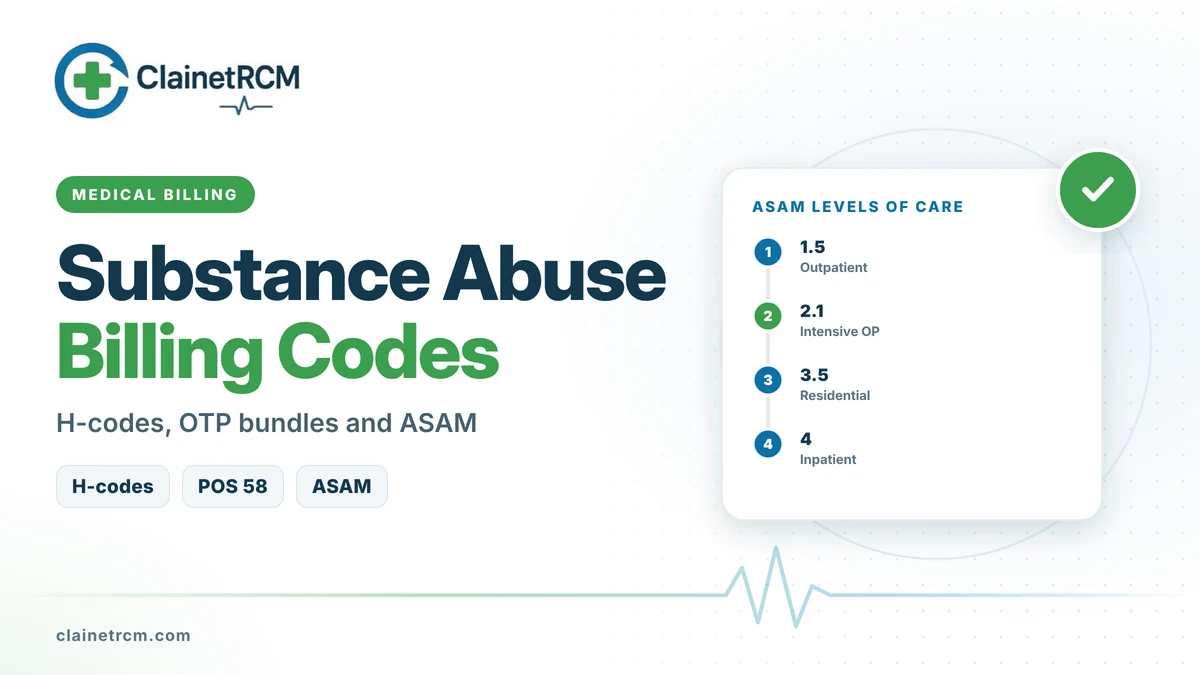
Substance abuse billing codes come from several different systems at once: CPT codes for clinical services, HCPCS H-codes that Medicaid and many commercial plans use for addiction treatment, Medicare’s weekly bundles for opioid treatment programs, and G-codes for office-based treatment. Which set you use depends on the payer, the setting and the level of care, which is why SUD billing trips up even experienced teams.
Quick answer: Medicaid and many commercial plans use H-codes such as H0001 (assessment), H0004 (individual counseling, per 15 minutes), H0005 (group counseling), H0015 (intensive outpatient), H0020 (methadone administration) and H2036 (treatment program, per diem). Medicare pays opioid treatment programs weekly bundles such as G2067 (methadone), G2068 (oral buprenorphine) and G2074 (non-drug), with add-ons like G2076 (intake) and G2080 (extra counseling), billed with POS 58. Office-based clinicians use G2086 to G2088, and screening uses SBIRT codes such as 99408. ASAM levels of care determine which codes fit each program.
Substance Abuse Billing Codes by Setting
| Setting | Common codes | Main payers |
|---|---|---|
| Outpatient counseling | 90832 to 90837, 90853, H0004, H0005 | Medicaid, commercial, Medicare (CPT only) |
| Intensive outpatient | H0015, S9480, revenue code 0906, Medicare IOP codes | Medicaid, commercial, Medicare |
| Opioid treatment program | G2067 to G2080, G0533, G0137 | Medicare, Medicare Advantage, many Medicaid and commercial plans |
| Office-based OUD treatment | G2086 to G2088 plus E/M | Medicare, some other payers |
| Residential treatment | H0018, H0019, H2036, revenue code 1002 | Medicaid, commercial |
| Withdrawal management | H0010 to H0014 | Medicaid, commercial |
| Screening and brief intervention | 99408, 99409, G0396, G0397, G2011, H0050 | All, by payer |
Common H-Codes for Substance Use Treatment
| Code | Description |
|---|---|
| H0001 | Alcohol and/or drug assessment |
| H0004 | Behavioral health counseling and therapy, per 15 minutes |
| H0005 | Alcohol and/or drug services, group counseling by a clinician |
| H0006 | Alcohol and/or drug services, case management |
| H0010 | Sub-acute detoxification, residential addiction program inpatient |
| H0011 | Acute detoxification, residential addiction program inpatient |
| H0014 | Ambulatory detoxification |
| H0015 | Intensive outpatient program, at least 3 hours a day, 3 days a week |
| H0018 | Behavioral health short-term residential, without room and board, per diem |
| H0019 | Behavioral health long-term residential, without room and board, per diem |
| H0020 | Methadone administration and/or service |
| H0038 | Self-help/peer services, per 15 minutes |
| H0048 | Alcohol and/or other drug testing, collection and handling only |
| H0050 | Brief intervention, per 15 minutes |
| H2034 | Halfway house services, per diem |
| H2036 | Alcohol and/or other drug treatment program, per diem |
Each state Medicaid program decides which H-codes it pays, how units are counted and which modifiers apply. Common modifiers include HF (substance abuse program), HG (opioid addiction treatment program), HQ (group setting), HA or HB (child or adult program), HD (pregnant or parenting women’s program) and HM to HP for the clinician’s education level.
Medicare Opioid Treatment Program Bundles
Medicare pays enrolled OTPs weekly bundled payments, where a week is seven continuous days. OTPs bill on the CMS-1500 with place of service 58 (non-residential opioid treatment facility).
| Code | Description |
|---|---|
| G2067 | Weekly bundle, methadone |
| G2068 | Weekly bundle, oral buprenorphine |
| G2069, G0533 | Bundles for injectable buprenorphine products |
| G2073 | Weekly bundle, extended-release injectable naltrexone |
| G2074 | Weekly bundle, no medication (non-drug services) |
| G2075 | Weekly bundle, medication not otherwise specified |
| G2076 | Add-on: intake activities for new patients |
| G2077 | Add-on: periodic assessment |
| G2078 | Add-on: take-home supply of methadone |
| G2079 | Add-on: take-home supply of oral buprenorphine |
| G2080 | Add-on: each additional 30 minutes of counseling in a week |
| G0137 | Intensive outpatient services in an OTP, minimum of 9 services in a 7-day period |
Overdose reversal medication supplied by the OTP has its own add-on codes, such as G2215, G2216, G1028 and G0532. Clinicians outside an OTP cannot use these codes.
Office-Based Opioid Use Disorder Treatment
Physicians and other practitioners who treat OUD in the office bill G2086 (initial month, at least 70 minutes), G2087 (subsequent months, at least 60 minutes) and G2088 (each additional 30 minutes) for care coordination, counseling and therapy, plus a separately billed E/M visit when medically necessary. The separate DEA waiver to prescribe buprenorphine was eliminated in 2023, so any practitioner with a standard DEA registration that includes Schedule III can prescribe it.
Screening and Brief Intervention (SBIRT)
| Code | Description |
|---|---|
| 99408 | Alcohol and/or substance abuse structured screening and brief intervention, 15 to 30 minutes |
| 99409 | Same, more than 30 minutes |
| G2011 | Medicare, 5 to 14 minutes |
| G0396, G0397 | Medicare, 15 to 30 minutes and more than 30 minutes |
ASAM Levels of Care and How They Bill
The ASAM Criteria, now in its fourth edition (2023), defines levels of care that payers use to authorize treatment. Many states are still moving from the third edition, so confirm which version your payers apply.
| ASAM level (4th edition) | Description | Typical billing |
|---|---|---|
| 1.5 | Outpatient therapy, under 9 hours a week | CPT psychotherapy codes, H0004, H0005 |
| 1.7 | Medically managed outpatient | E/M, G2086 to G2088, OTP bundles |
| 2.1 | Intensive outpatient, 9 to 19 hours a week | H0015, S9480, revenue code 0906 |
| 2.5 | High-intensity outpatient, 20 or more hours a week (formerly partial hospitalization) | Per diem codes or revenue codes 0912 and 0913, by payer |
| 2.7 | Medically managed intensive outpatient | Per diem codes with withdrawal management services |
| 3.1, 3.5 | Clinically managed low- and high-intensity residential | H2036, H0018, H0019, revenue code 1002 |
| 3.7 | Medically managed residential | Per diem codes, including withdrawal management |
| 4 | Medically managed inpatient | Hospital inpatient billing |
Medicaid and Medicare Rules to Know
- IMD exclusion. Federal Medicaid generally does not pay for adults aged 21 to 64 in institutions for mental diseases with more than 16 beds, but most states use Section 1115 waivers to pay for SUD residential treatment in these facilities.
- Medicare coverage. Medicare covers OTP services, office-based OUD treatment, counseling and, since 2024, intensive outpatient services in hospital outpatient departments, community mental health centers, FQHCs, RHCs and OTPs. It does not cover non-hospital residential programs.
- Authorization. Most Medicaid and commercial plans require authorization with ASAM-based documentation for IOP, residential and withdrawal management.
- Diagnosis coding. Use F10 to F19 codes that capture the substance, use, abuse or dependence, remission status and any induced disorders.
Frequently Asked Questions
HCPCS Level II codes, H0001 to H2037, used mainly by Medicaid and many commercial plans for behavioral health and addiction services that CPT does not describe.
Generally no. Medicare uses CPT codes, OTP bundles and G-codes for substance use treatment.
POS 58, non-residential opioid treatment facility, for Medicare OTP claims.
No. OTP codes are for Medicare-enrolled opioid treatment programs. Office-based practices use G2086 to G2088 and E/M codes.
It depends on the state and plan. The fourth edition was published in 2023, but many programs still authorize using third edition levels during the transition.
Final Thoughts
Substance abuse billing codes vary by payer, setting and level of care, so every program needs a clear map of which codes each payer accepts. Our substance abuse billing team manages H-codes, OTP bundles and authorizations for treatment programs, and our specialty medical billing guide explains why specialty expertise pays off. Practices integrating SUD care into primary care should also read our guide to behavioral health integration codes.
Billing Built for Addiction Treatment Programs
We bill H-codes, OTP bundles and levels of care correctly, manage authorizations and keep SUD programs compliant with payer rules.
Talk to Our SUD Billing Team
Written by
ClainetRCM Billing Team
ClainetRCM is a Boston-based revenue cycle management company specializing in medical billing, coding, credentialing and denial management for healthcare providers across all 50 states. Our AAPC and AHIMA certified team works inside your existing EHR, files claims within 24 to 48 hours and reviews every AR bucket on a 14-day cycle.